Boeing-Sikorsky RAH-66 Comanche
The RAH-66 Comanche program: its technological innovations, the challenges behind its cancellation, and the future of dedicated armed reconnaissance helicopters. Illustrated with archival photographs and original artwork.
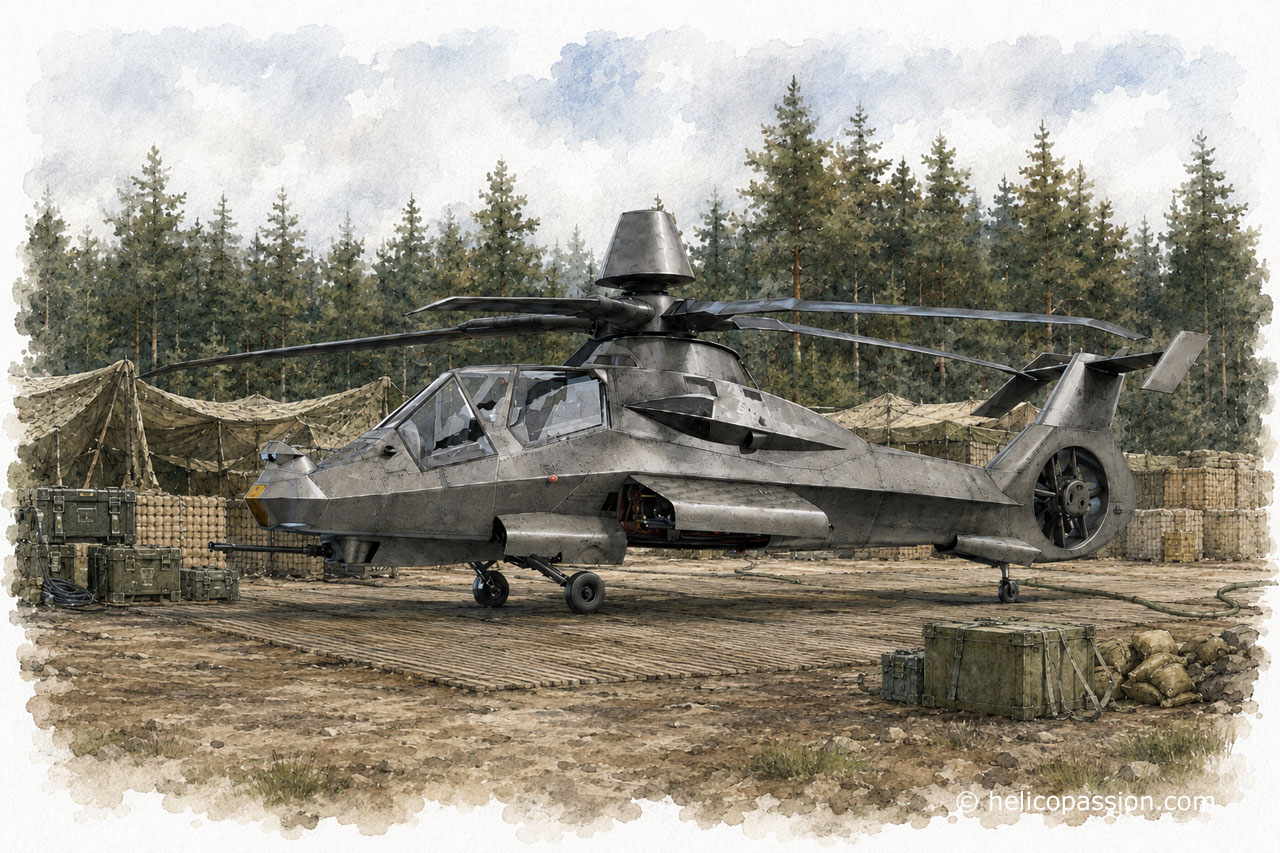
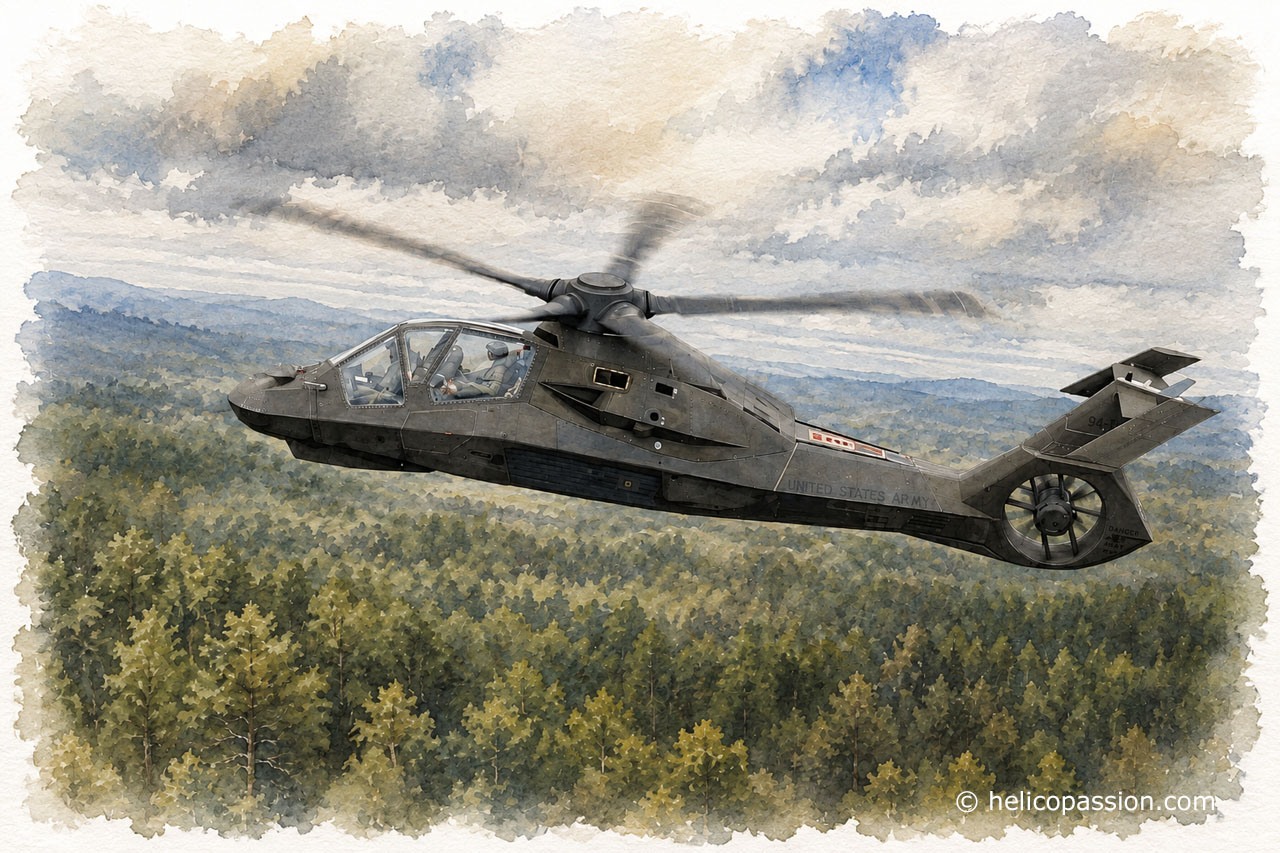 (Helicopassion illustration with AI, based on a photograph by Sikorsky) RAH66 Comanche helicopter in stealth reconnaissance configuration: nose-mounted cannon retracted into its housing, weapons bays closed
Developed by Boeing and Sikorsky for the US Army, the RAH-66 Comanche was designed to replace the OH-58 Kiowa and operate alongside the AH-64 Apache. It was intended to combine reconnaissance, target designation, combat and data sharing with significantly reduced radar, infrared and acoustic signatures. Only two prototypes flew, the first in 1996 and the second in 1999, before the program was canceled in February 2004.
The program ended before all the systems planned for production aircraft could be integrated and flight-tested. Some of the illustrations on this page therefore show the Comanche as it was envisioned for operational service, including configurations with a full weapons load or external stub wings.
Designed for stealth
Reducing the helicopter's detectability was a central design objective. The shape of the airframe, composite materials, retractable weapons and landing gear, a shrouded main rotor hub, the ducted Fantail tail rotor and a specially designed exhaust system all contributed to reducing its radar, infrared and acoustic signatures.
Radar signature tests using a full-scale mock-up showed promising results. However, the program ended before the aircraft's stealth performance could be assessed with the full complement of sensors, antennas and weapons planned for operational service.
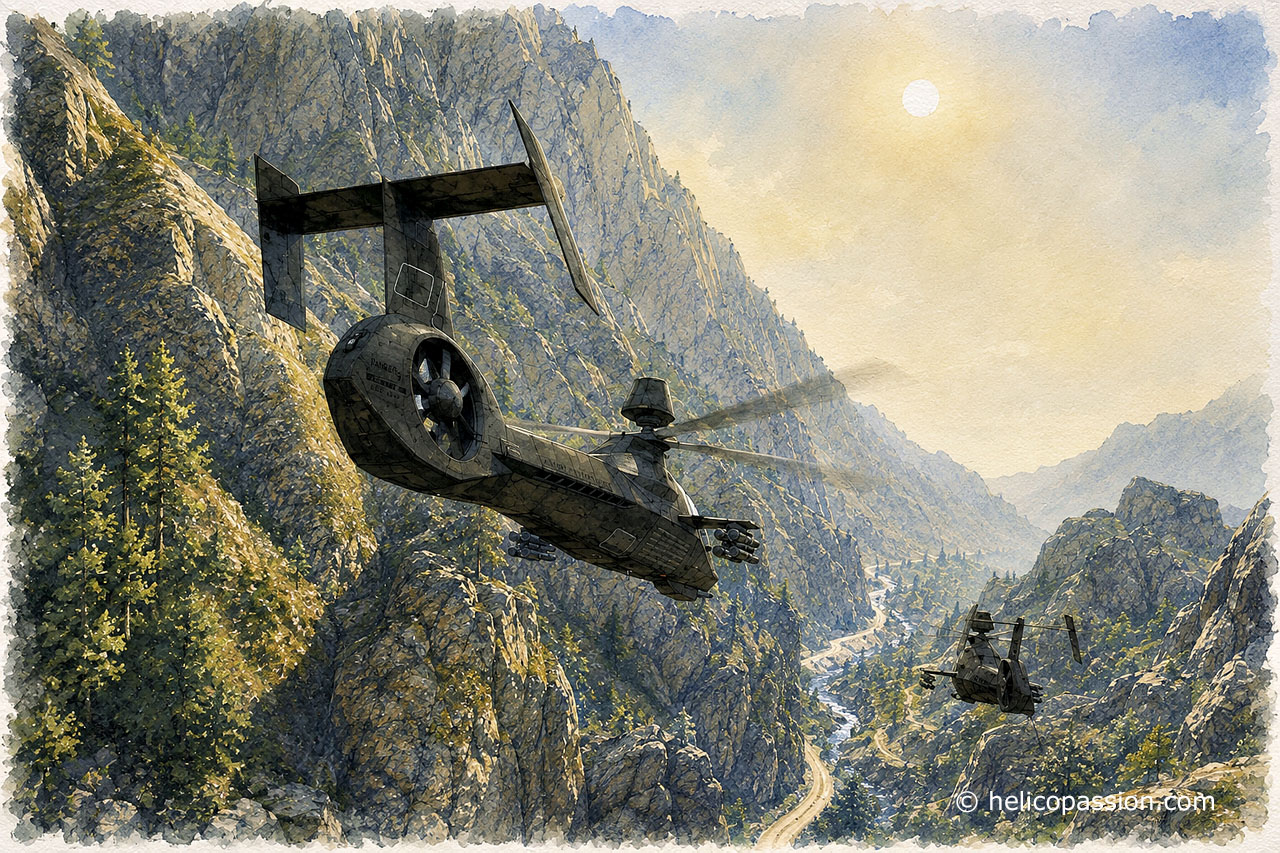 (Helicopassion illustration with AI) Two RAH-66 Comanche helicopters on a tactical flight through a valley
Refining the tail design
The Comanche's tail underwent several design changes during flight testing. The original configuration featured a vertical fin above the Fantail and a T-tail. Flight tests revealed problems with directional stability and aerodynamic vibrations affecting the tail assembly.
In December 2000, prototype No. 1 was fitted with a redesigned tail featuring vertical endplates on the horizontal stabilizer. This adjustable configuration was intended to improve handling qualities and help define the tail design for production aircraft. Photographs taken at different stages of the flight test program show how the Comanche's appearance evolved.
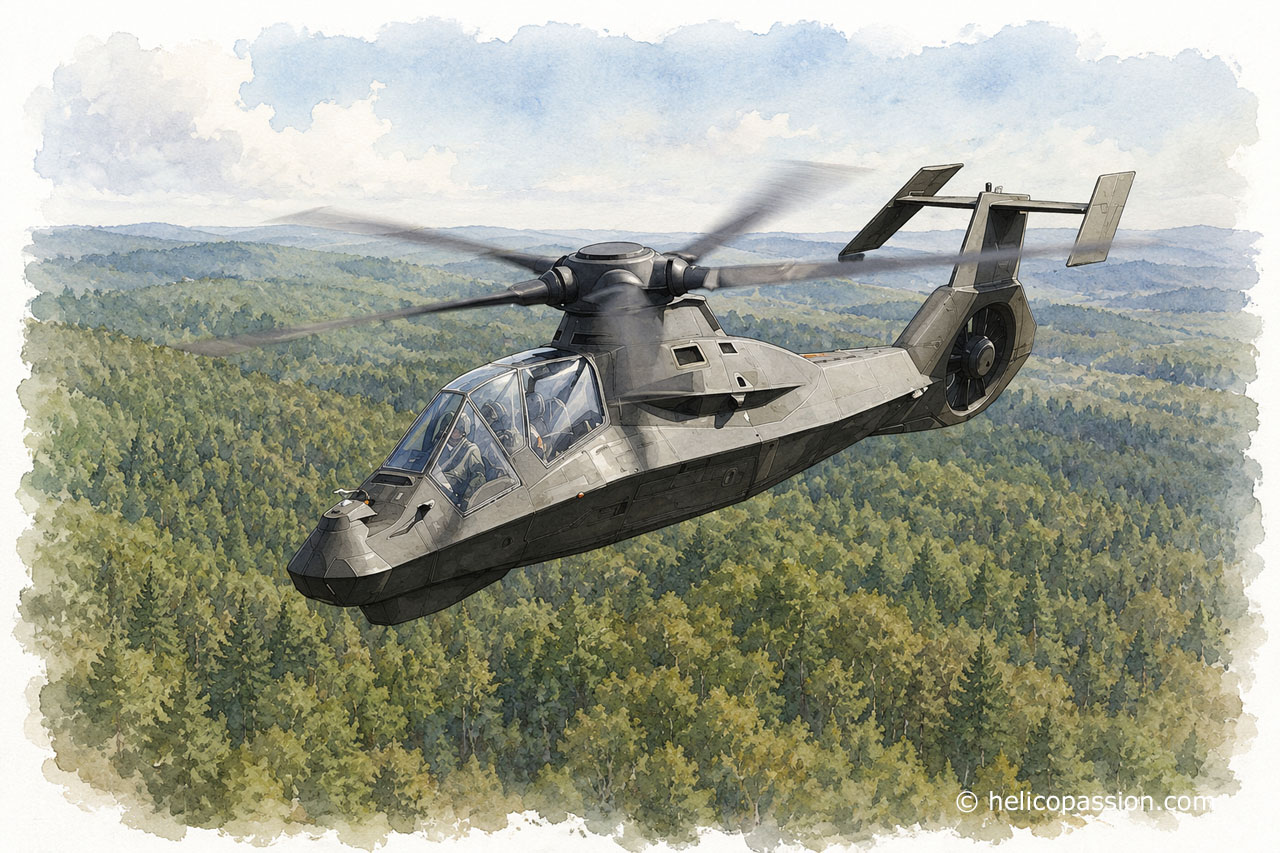 (Helicopassion illustration with AI, based on a photograph by Sikorsky) RAH-66 Comanche with the redesigned tail introduced in December 2000
Key recognition features
- Faceted airframe designed to reduce radar signature
- Ducted Fantail tail rotor
- Tandem cockpit
- Retractable landing gear
- Shrouded main rotor hub
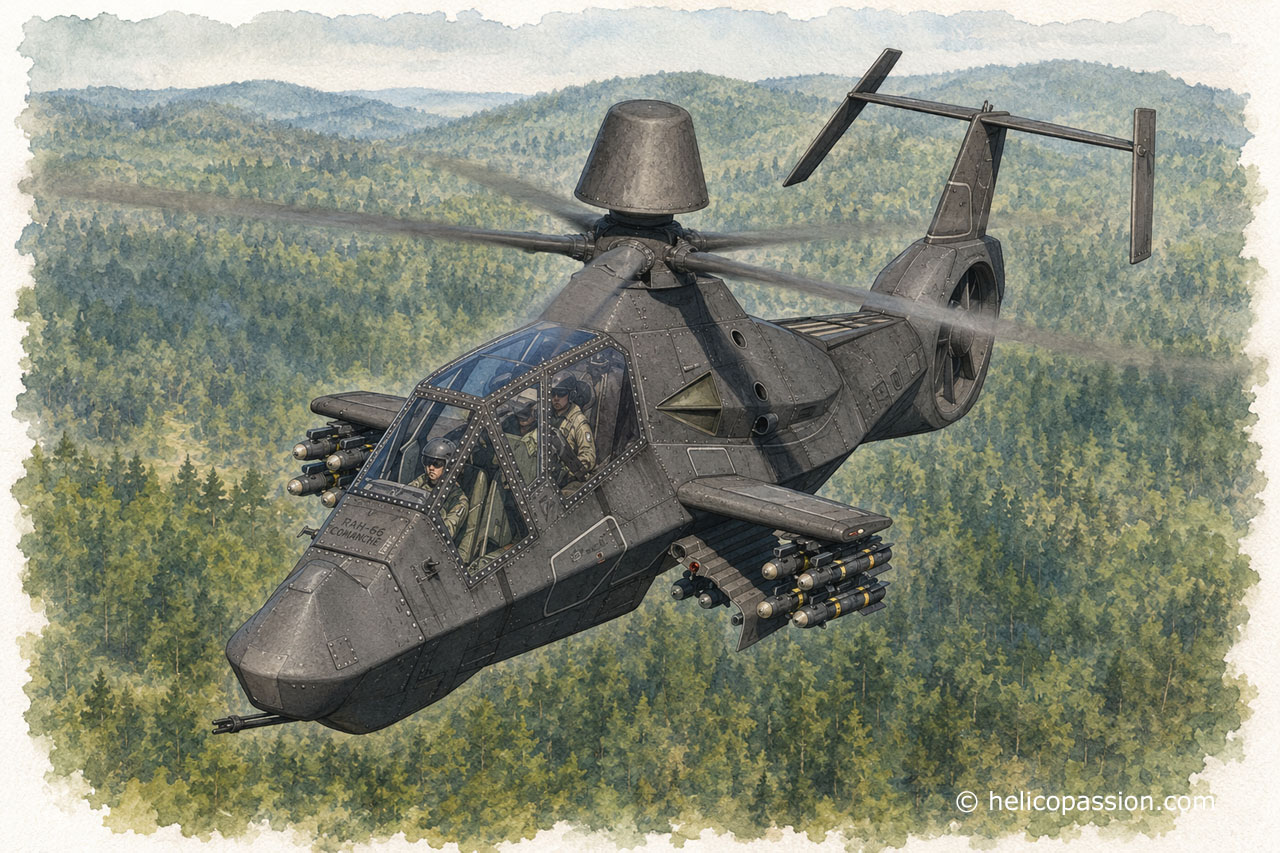 (Helicopassion illustration with AI) The Comanche as envisioned in its combat configuration, with mast-mounted radar, cannon deployed and external stub wings. Its appearance contrasts sharply with the clean configuration shown at the top of this page.
Program milestones
1996 — First flight of prototype No. 1.
1999 — The second prototype joins the flight test program.
December 2000 — Prototype No. 1 is fitted with a substantially redesigned tail assembly.
October 2002 — The US Army reduces its planned purchase from 1,200 to 650 helicopters.
2003-2005 — Eight aircraft were originally scheduled to undergo operational evaluation, ahead of a planned 2006 entry into service.
February 23, 2004 — The US Army announces the cancellation of the program.
Why the program was canceled
The Comanche was to become the US Army's primary armed reconnaissance helicopter. Lighter and stealthier than the Apache, it would locate and identify targets, relay their coordinates and engage them when necessary.
Development, however, took far longer than expected. By the early 2000s, many of the program's critical technologies were considered mature on their own, but integrating them into an operationally representative aircraft remained an unresolved challenge.
Rising costs, schedule delays and systems integration risks put increasing pressure on the program. At the same time, operations in Afghanistan and Iraq were reshaping Army aviation priorities. The Army decided to redirect funding toward upgrading its existing fleet, acquiring additional helicopters and developing unmanned aircraft.
The Comanche was not canceled because the prototypes failed to fly. The problem was a costly, delayed development program with several key operational capabilities still awaiting integration and validation.
The search for a replacement for the OH-58 Kiowa Warrior continued after the Comanche, first with the ARH-70 Arapaho and later with the Bell 360 Invictus under the FARA program. Both efforts were eventually canceled.
Technical specifications
Dimensions:
- Main rotor diameter: 11.9 m
- Overall length (rotors turning): 14.2 m
- Fuselage length: 13.2 m
- Height: 3.3 m
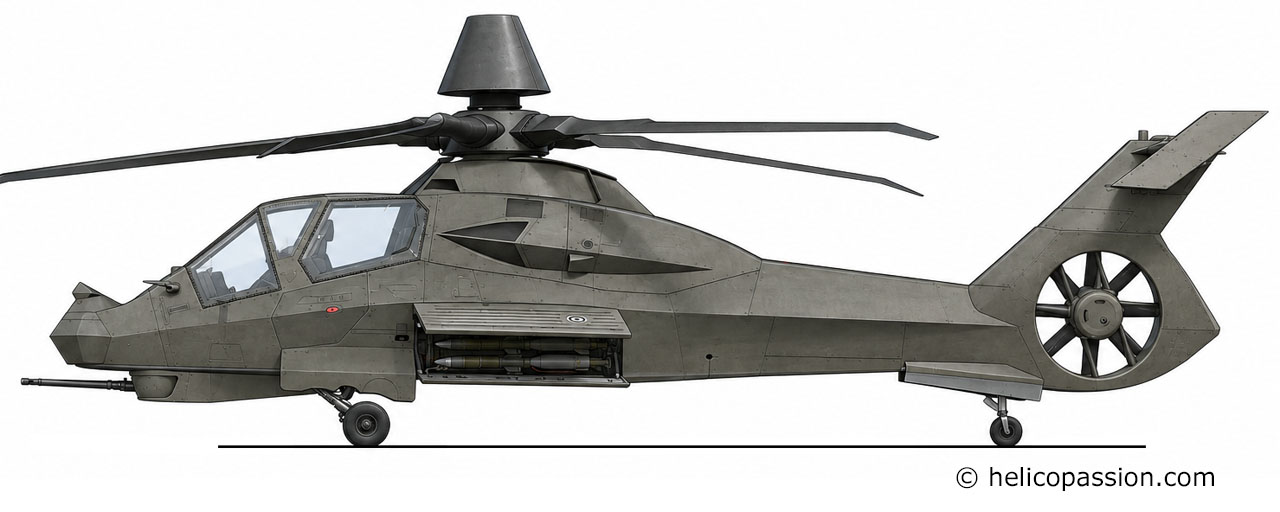 (Helicopassion profile drawing with AI) RAH-66 Comanche side profile
Weights:
- Empty weight: 3,500 kg
- Maximum weight: 5,800 kg, 7,800 kg with external fuel tanks
Speed: 320 km/h
Range: 2,300 km with auxiliary fuel tanks
Crew: Two, with the pilot in the front seat and the gunner in the rear
Other features:
- Three-axis side-stick flight controller (pitch, roll and yaw), eliminating the need for conventional anti-torque pedals.
- Pressurized cockpit.
Weapons and stealth
The Comanche's weapons systems were designed around its low-observability requirements. The XM301 20 mm cannon could retract into its housing when not in use, while missiles were carried in two internal weapons bays to minimize their impact on the helicopter's radar signature.
The missiles were mounted on the weapons bay doors, which brought them into firing position when opened. This arrangement allowed the Comanche to retain a clean external profile until its weapons were needed, without relying on permanent external weapons stations.
Optional stub wings were planned for missions where firepower took precedence over stealth. Each wing could carry four additional Hellfire missiles, at the expense of a larger radar signature. The wings were never fitted to either prototype or flight-tested.
Planned armament:
- XM301 20 mm cannon (+15°/-45° elevation, +/-120° traverse, firing rate of 750 or 1,500 rounds per minute, ammunition capacity of 500 rounds).
- Internal weapons bays: 4 Hellfire air-to-ground missiles and 2 Stinger air-to-air missiles (or 6 Hellfire or 12 Stinger missiles).
- With external stub wings: 8 additional Hellfire missiles (or 16 additional Stinger missiles or 56 additional 70 mm rockets).
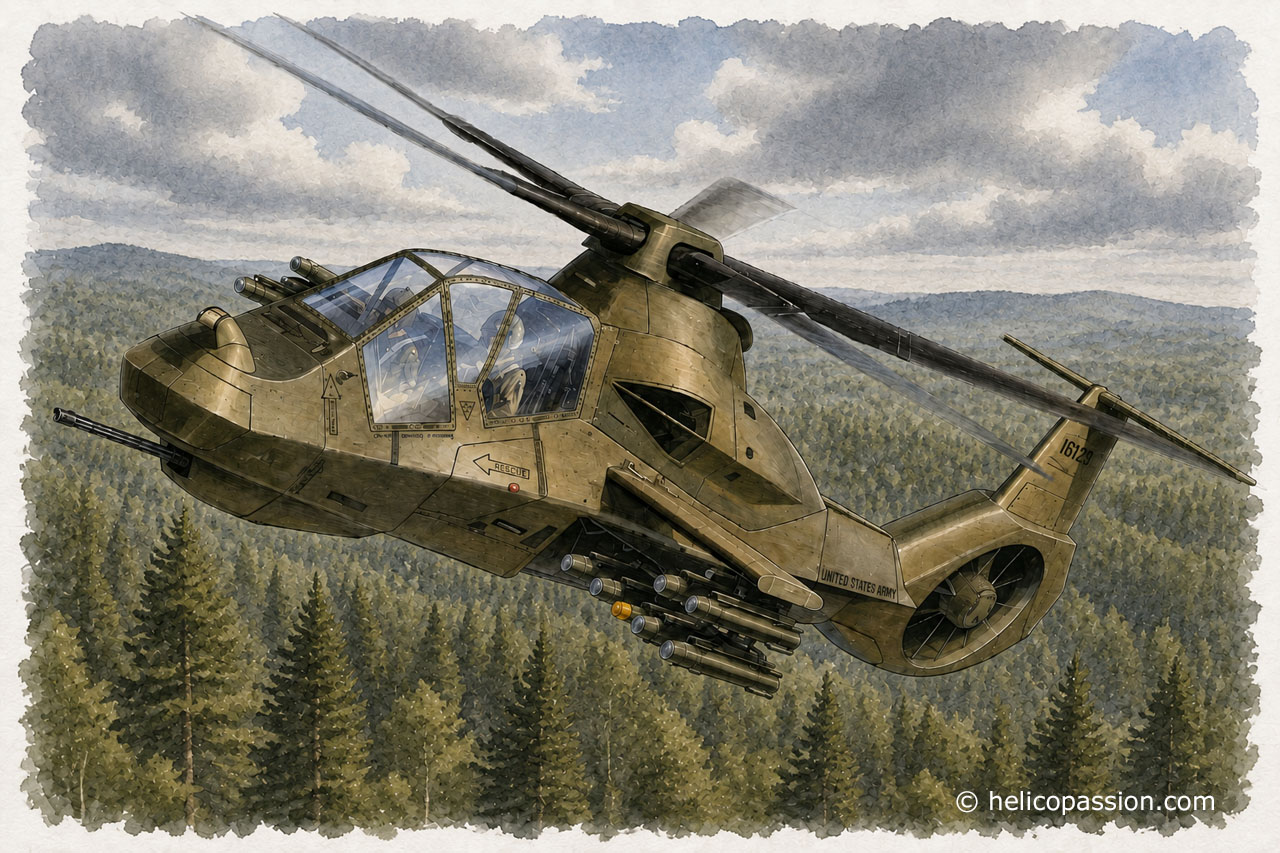 (Helicopassion illustration with AI, based on an image by Revell) Comanche with external stub wings and the original tail design. The wings were intended to provide a substantial increase in weapons payload at the expense of stealth
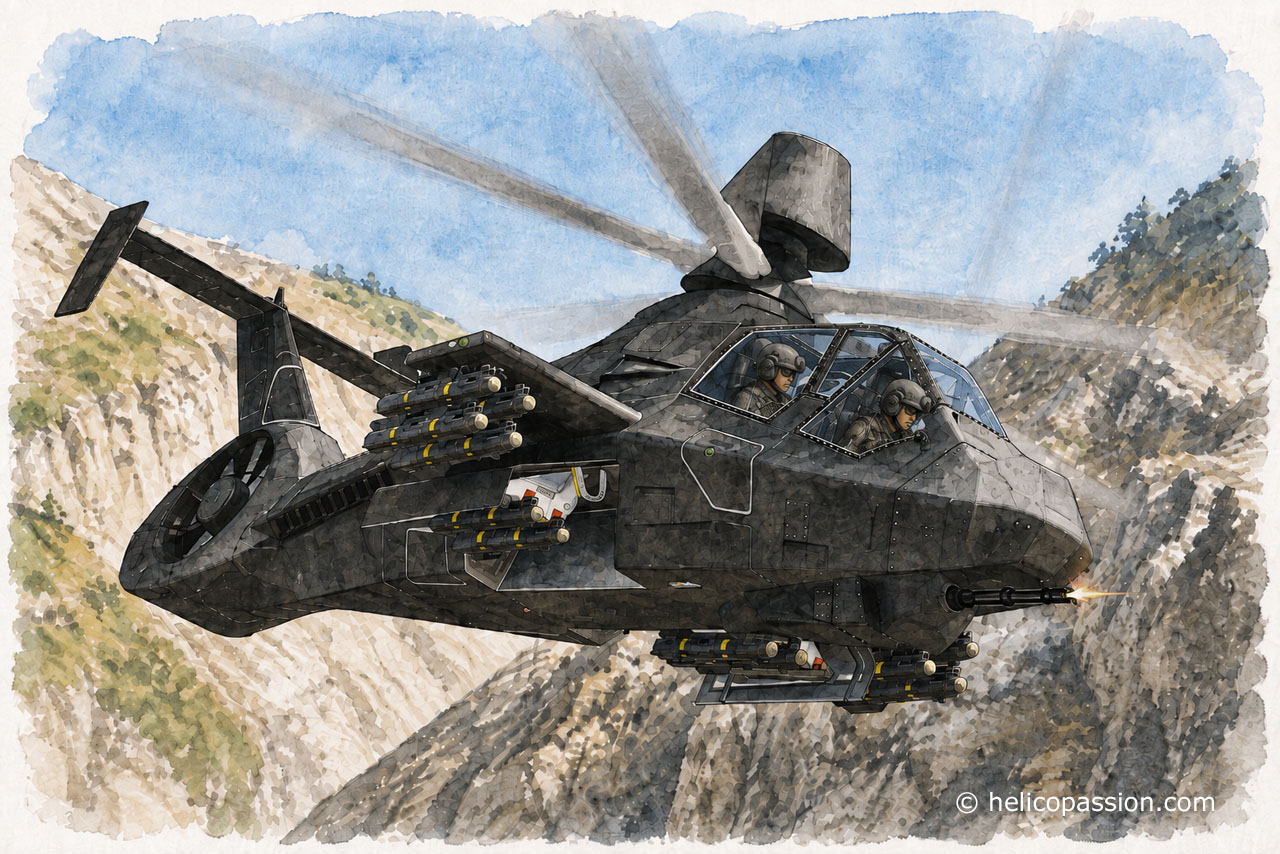 (Helicopassion illustration with AI) An artist's impression of the Comanche in combat, with its cannon deployed and weapons in firing position
The prototypes in photographs
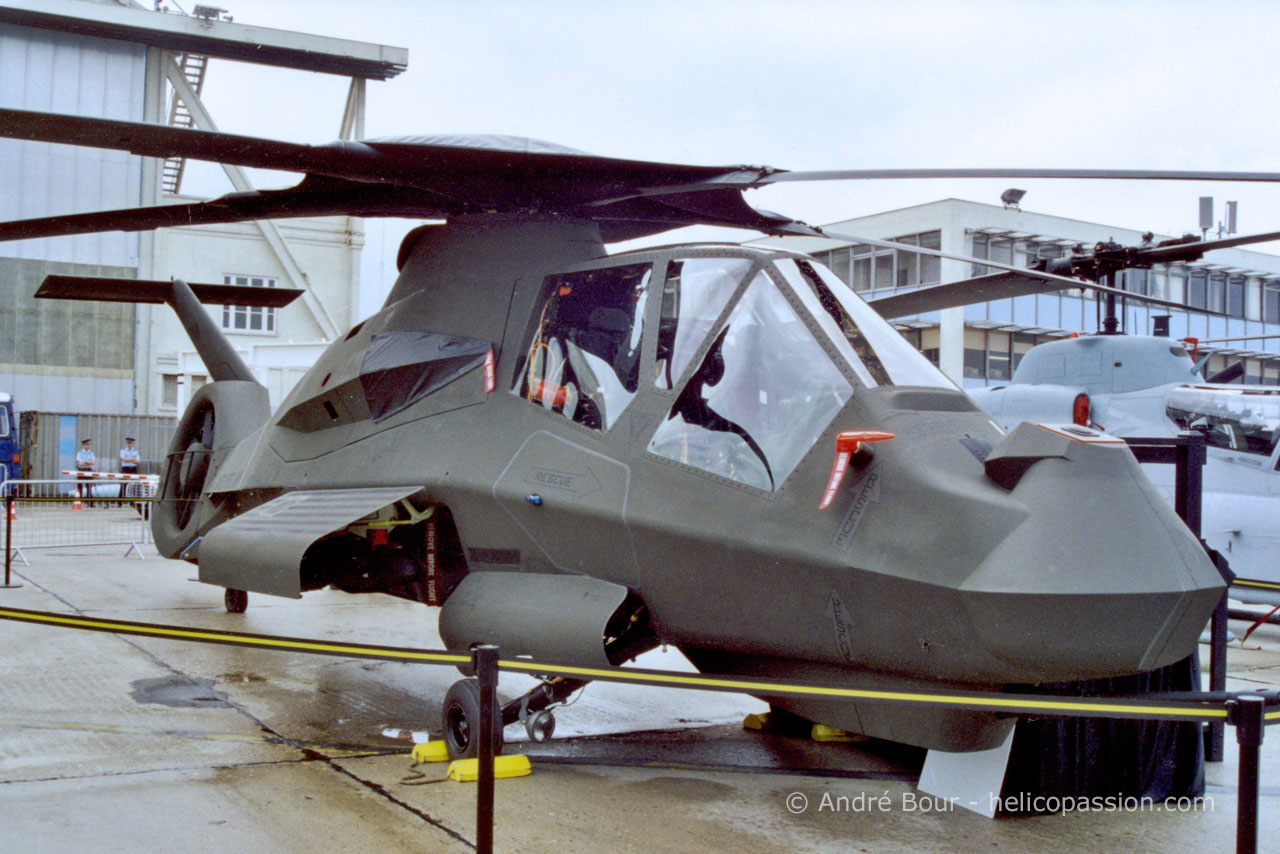
(Photo André Bour - Helicopassion) RAH-66 Comanche on display at the 1999 Paris Air Show, before the tail modifications introduced in 2000. The rotor head is concealed beneath a protective cover

(Photo Sikorsky) The first RAH-66 Comanche prototype in flight

(Photo Sikorsky)Both RAH-66 Comanche prototypes in flight

(Photo Sikorsky) RAH-66 prototype fitted with a fairing simulating the planned fire control radar. This installation allowed its aerodynamic effects to be studied before integration of the actual radar system
 (Photo Sikorsky)Prototype No. 1 in December 2000, undergoing evaluation with its redesigned tail and vertical endplates
A career in the virtual world
The Comanche became surprisingly well known long before it was ready for operational service. In 1992, four years before the first prototype flew, NovaLogic featured the helicopter in Comanche: Maximum Overkill, the first in a long series of combat flight simulation games. Fully armed and flying at very low altitudes through complex terrain, the virtual Comanche was in many ways closer to the helicopter envisioned for Army service than to the two prototypes seen in archival photographs.
 (Helicopassion illustration with AI) The Comanche as it might have appeared in operational service, with mast-mounted radar, open weapons bays and integrated armament
 (WarThunder illustration) The Comanche lived on in the virtual world long after the program was canceled. Video games and simulations allowed it to perform missions and demonstrate capabilities it never had the opportunity to prove in real life
The Comanche's legacy
As a military acquisition program, the Comanche was a failure. After nearly two decades of development, not a single operational aircraft entered service, and the US Army ultimately chose to invest elsewhere. Yet the concepts explored during its development — signature reduction, sensor integration, data sharing and networked operations — remained relevant.
There is an interesting parallel with another Sikorsky helicopter. In addition to its partnership with Boeing on the Comanche, Sikorsky manufactures the UH-60 Black Hawk. In 2011, Operation Neptune Spear revealed the existence of extensively modified Black Hawks designed for reduced detectability. No direct technological link to the Comanche has been publicly established, and the aircraft remain largely classified. Their existence nevertheless demonstrates that the pursuit of stealth technology for US military helicopters did not end with the RAH-66 program.