Helicopassion illustrations
Field photography is at the heart of Helicopassion's documentary approach. Maps, infographics, side-view profiles, artistic illustrations and historical reconstructions enrich this documentation. This page presents the different categories of images used on the website, their purpose and how they are produced.
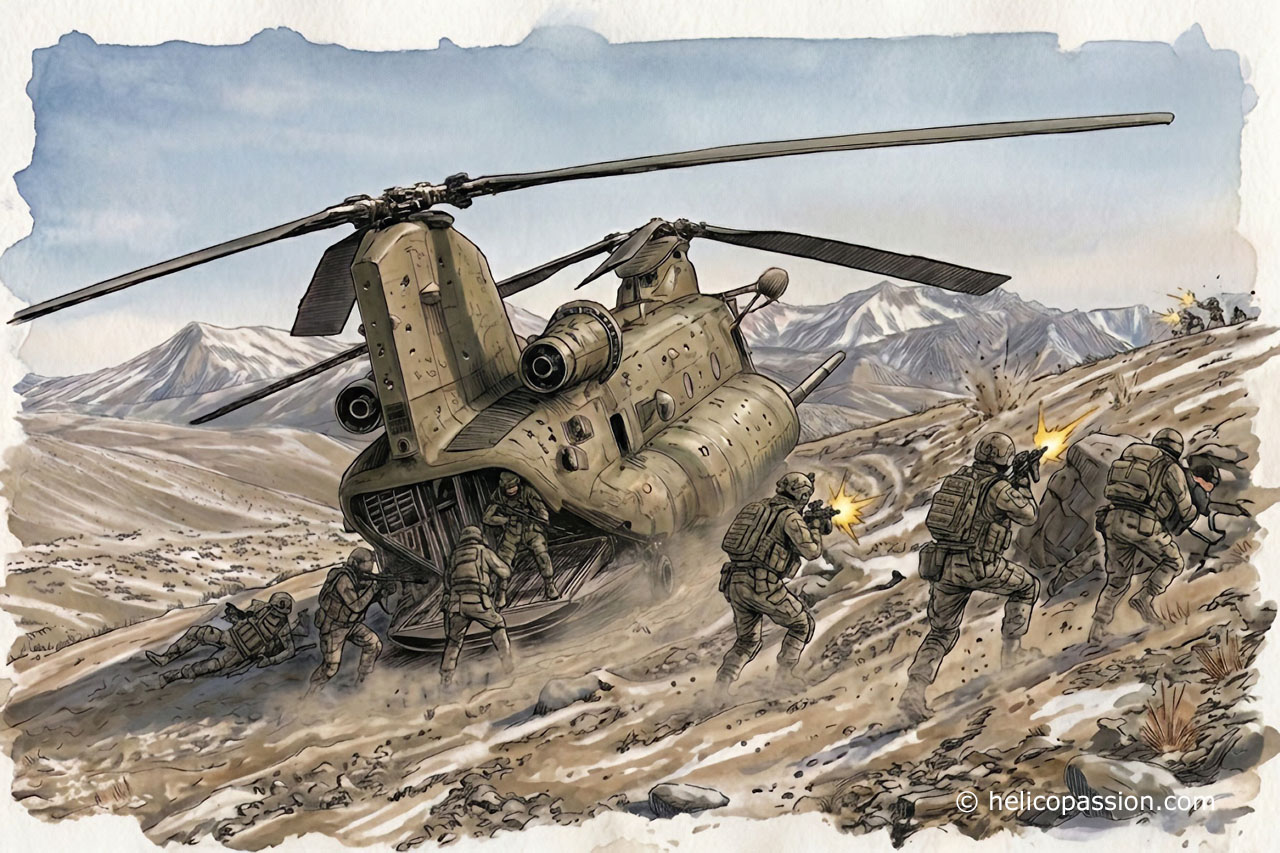 (Helicopassion historical reconstruction with AI)
An example of a historical reconstruction by Helicopassion: the fighting around a downed MH-47 Chinook at Takur Ghar, Afghanistan, in 2002.
On this page: The role of artificial intelligence • The 10 image categories • Illustration gallery • Visual Collections
Photography and illustration: two distinct roles
Photography captures a moment, records an activity and conveys an atmosphere. It invites us to look at the aircraft, the women and men who operate them, and the environments in which they work. Beyond their documentary value, photographs also convey emotion and a personal perspective on the world of helicopters.
Illustration extends these possibilities. It can depict scenes that were never photographed, reconstruct past events, compare aircraft within a consistent visual setting or place them in their operational environment. It can also create the image we would have liked to capture, but which remains beyond reach because of distance, circumstances or the photographic resources required.
Photographs and reference material
Helicopassion's documentary illustrations are based on photographs or reference documents. Priority is given to its own image library, which may be supplemented, depending on the subject, by photographs from contributors, operators or manufacturers, as well as archival material.
An illustration may therefore combine several sources: photographs of helicopters, views of landscapes and other documents used to check the aircraft's configuration, livery, markings and the context of the scene depicted.
Artistic illustrations and historical reconstructions share a common visual identity combining line drawing, colour and watercolour edges against a white background. This treatment makes them visually distinct from original photographs.
What does “with AI” mean?
Helicopassion has used graphic design, image editing and digital compositing tools for many years. The emergence of artificial intelligence has broadened the possibilities for creating these illustrations.
The process involves selecting reference material, defining the composition and creating the artwork. Particular attention is paid to the accurate depiction of helicopters and their surroundings.
In the interests of transparency, in keeping with the spirit of the European Union's AI Act, illustrations to which artificial intelligence has made a significant contribution carry the label “with AI”.
These images are not photographic records. They are visual representations intended to illustrate, explain or reconstruct a subject. Despite the care taken in their creation, they may contain inaccuracies, particularly in certain technical or historical details.
Every illustration is carefully reviewed and, where necessary, undergoes successive revisions. If the result does not meet Helicopassion's standards of documentary accuracy or visual quality, it is not published.
When an illustration is based directly on one or more identifiable photographs, their source is stated in the accompanying image credit.
On Helicopassion, a photograph whose content has been altered for editorial purposes is never presented as an original photograph, regardless of the technique used. Whenever an image is used to create a composite, place an aircraft in a different setting or reconstruct an event, the result is published as an illustration rather than as a photograph. Helicopassion illustrations feature distinctive watercolour edges, allowing readers to recognise them immediately.
The 10 image categories on Helicopassion
1. Photography
Photography plays a central role on Helicopassion. Whether taken by its founder, André Bour, or by the hundreds of photographers who contribute to the website, these images reflect a hands-on approach, documenting aircraft and the people who operate them.
More than 30,000 photographs are featured on Helicopassion. Often arranged in photographic series, they document aircraft, their equipment, missions and operational environments.
2. Digital photograph restoration
Digital restoration improves the clarity of older photographs of documentary interest through colour and contrast correction, grain reduction and the removal of scratches and defects caused by ageing photographic media. The aim is to restore the full value of the photograph while preserving its original content.
 (Archival photograph)
A rare archival photograph of an RAF CH-47 Chinook in IFOR markings
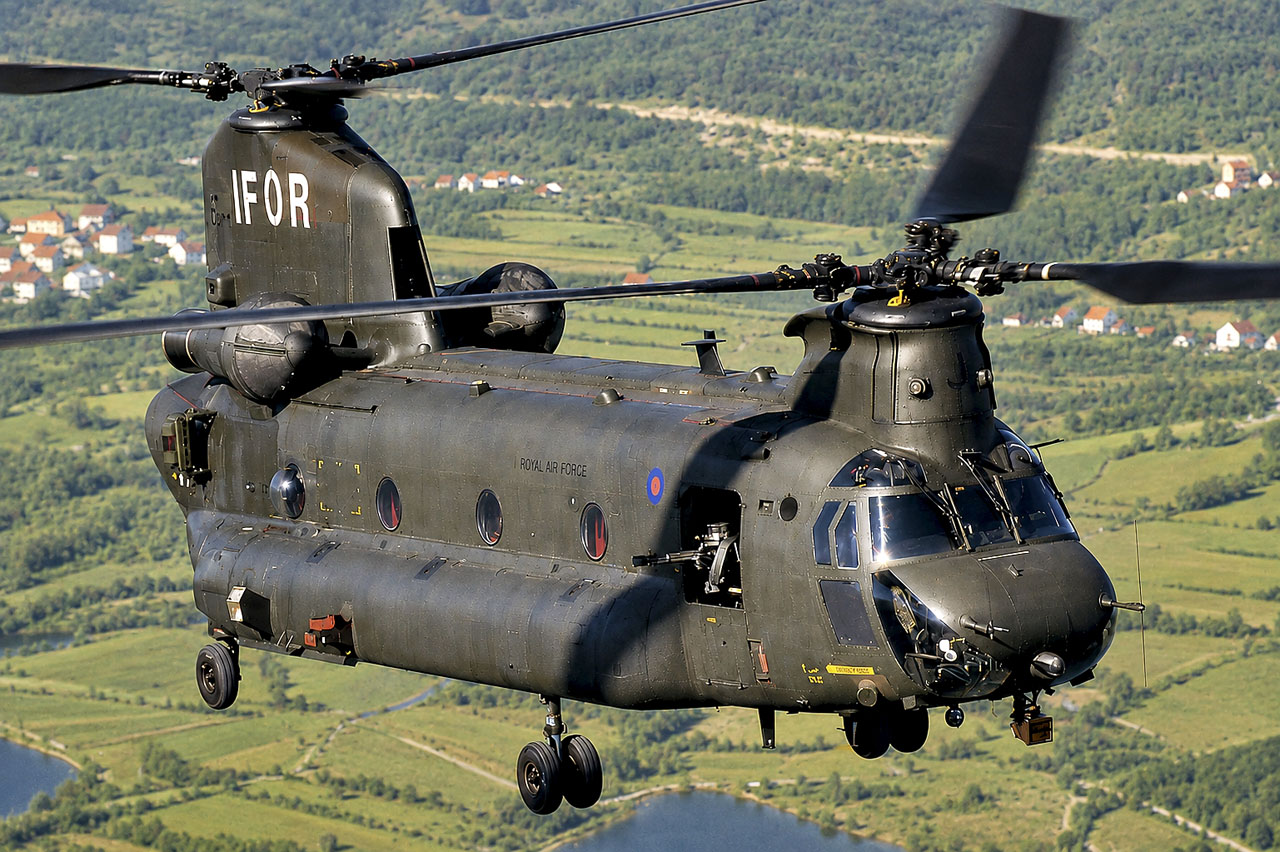 (Archival photograph, digital restoration by Helicopassion)
Digital restoration improves the visual quality of this archival photograph while preserving its documentary content.
3. Maps
Numerous interactive maps created with Google Maps place field reports and events in their geographical context. Illustrated maps are also produced to help readers understand historical events, routes and helicopter operations.
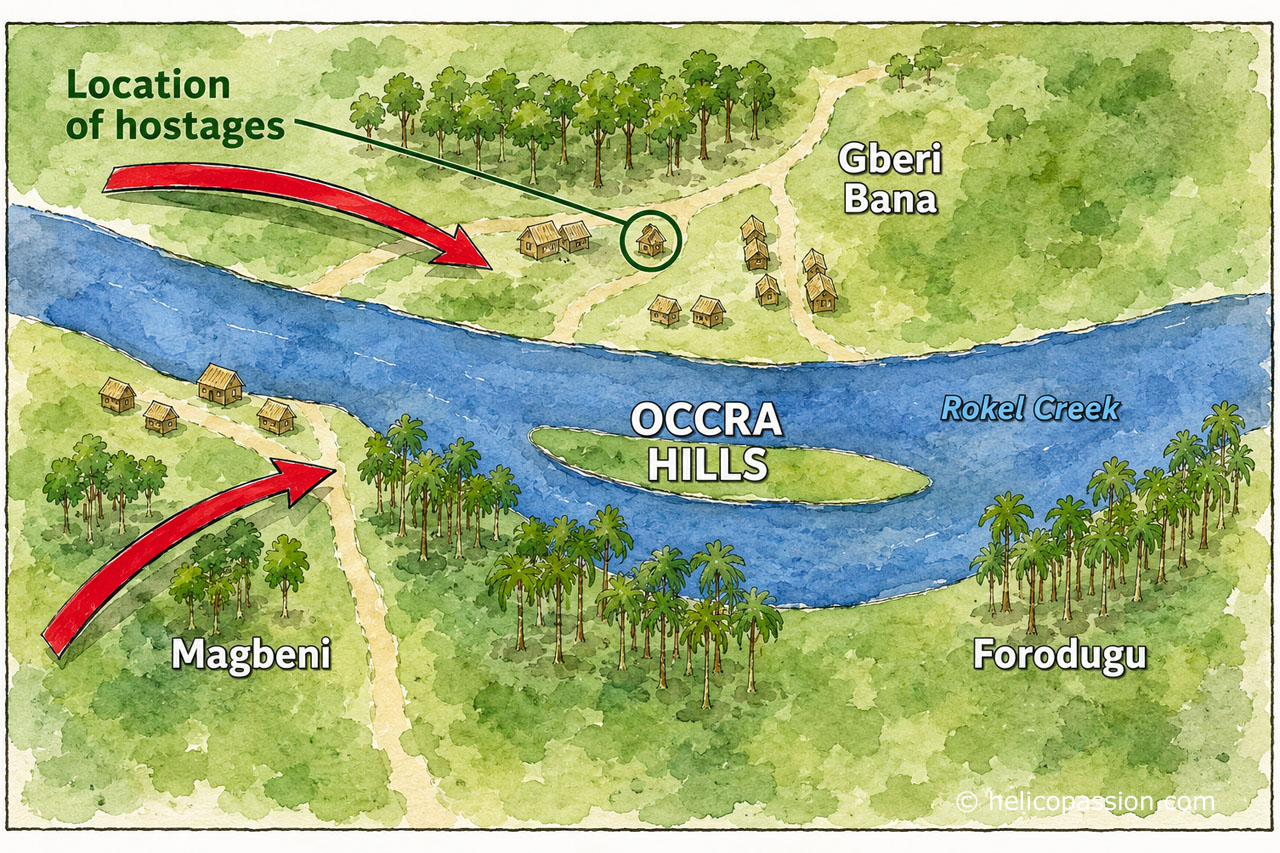
(Helicopassion map with AI)
Operation Barras – a helicopter-borne assault at Rokel Creek, Sierra Leone, on 10 September 2000 to free hostages held by an armed militia
See the Boeing CH-47 Chinook dossier (in French)
4. Infographics
Infographics provide a visual summary of technical or historical information, compare aircraft, illustrate their development and put different aviation programmes into perspective.
 (Helicopassion infographic)
An overview of the two US Army combat helicopter selection programmes
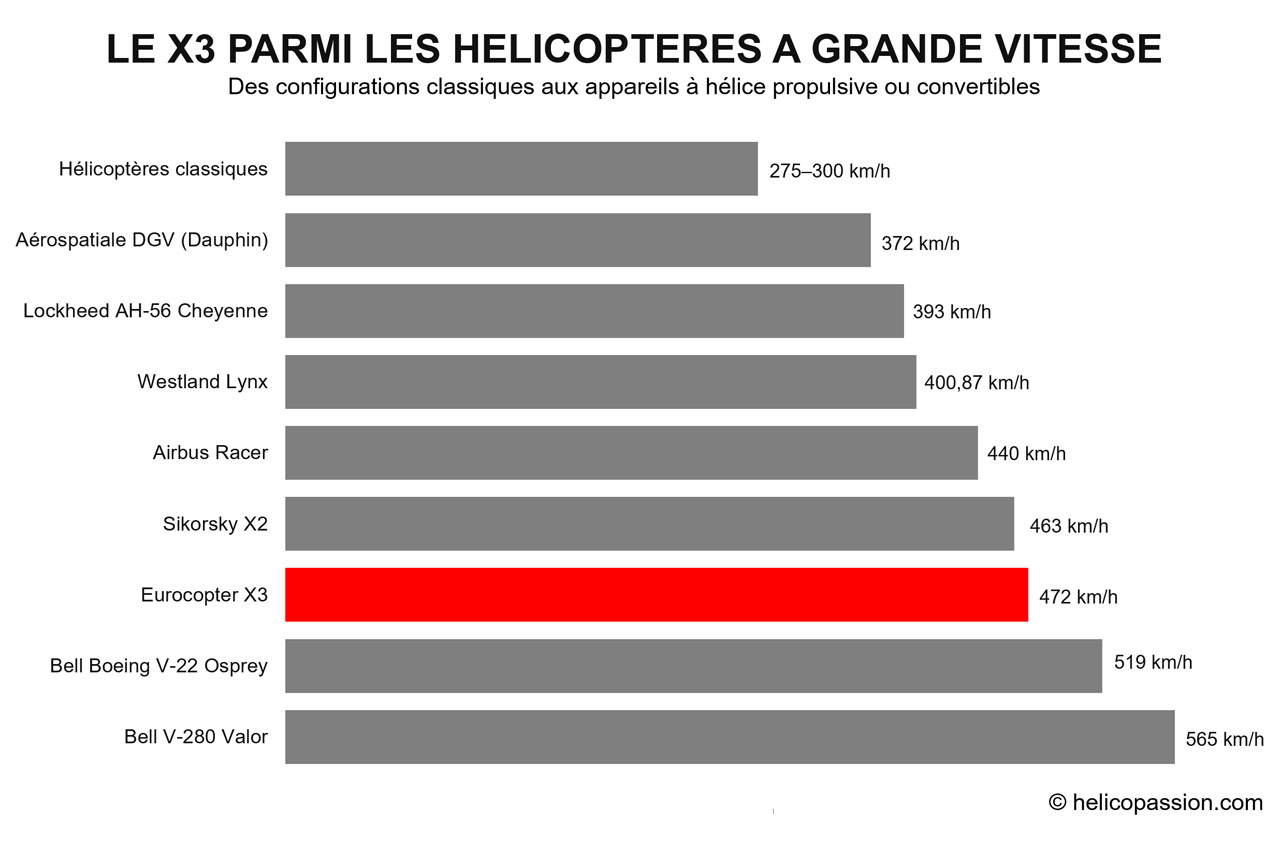 (Helicopassion infographic)
An infographic placing the X3 in the context of high-speed helicopters with pusher propellers and tiltrotor aircraft
5. Three-view drawings
Drawn from manufacturers' technical documents or archives, three-view drawings help readers understand a helicopter's geometry, proportions and the layout of its main components. They complement photographs in explaining an aircraft's design.
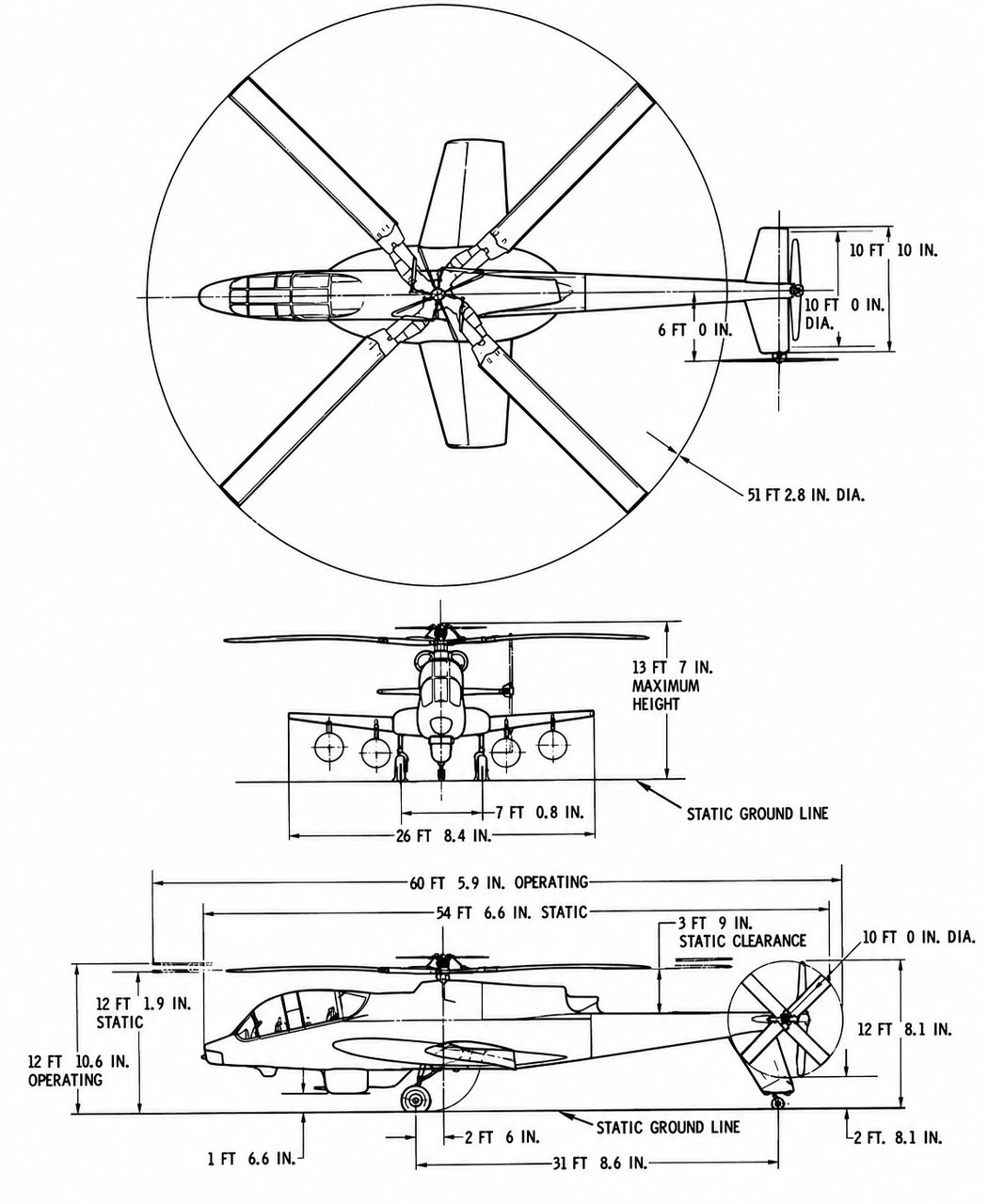 (US Army illustration) Three-view drawing of the AH-56 Cheyenne showing the aircraft's overall proportions and the layout of its main components
6. Side-view profiles
Side-view profiles have traditionally played an important role in aviation publications. They remain an excellent way to compare aircraft variants, equipment, liveries and camouflage schemes.
Since its early days, Helicopassion has featured side-view profiles created by artists whose work enriches its visual documentation.
 (Illustration by Patrice Gaubert)
Side-view profile of a French Sécurité civile Alouette III
Helicopassion also creates its own series of side-view profiles based on photographic references. Brought together on comparative plates, these profiles highlight the range of aircraft, equipment and liveries photographed over the years by Helicopassion and its contributors, and illustrate the diversity of civilian and military operators within a single helicopter family.
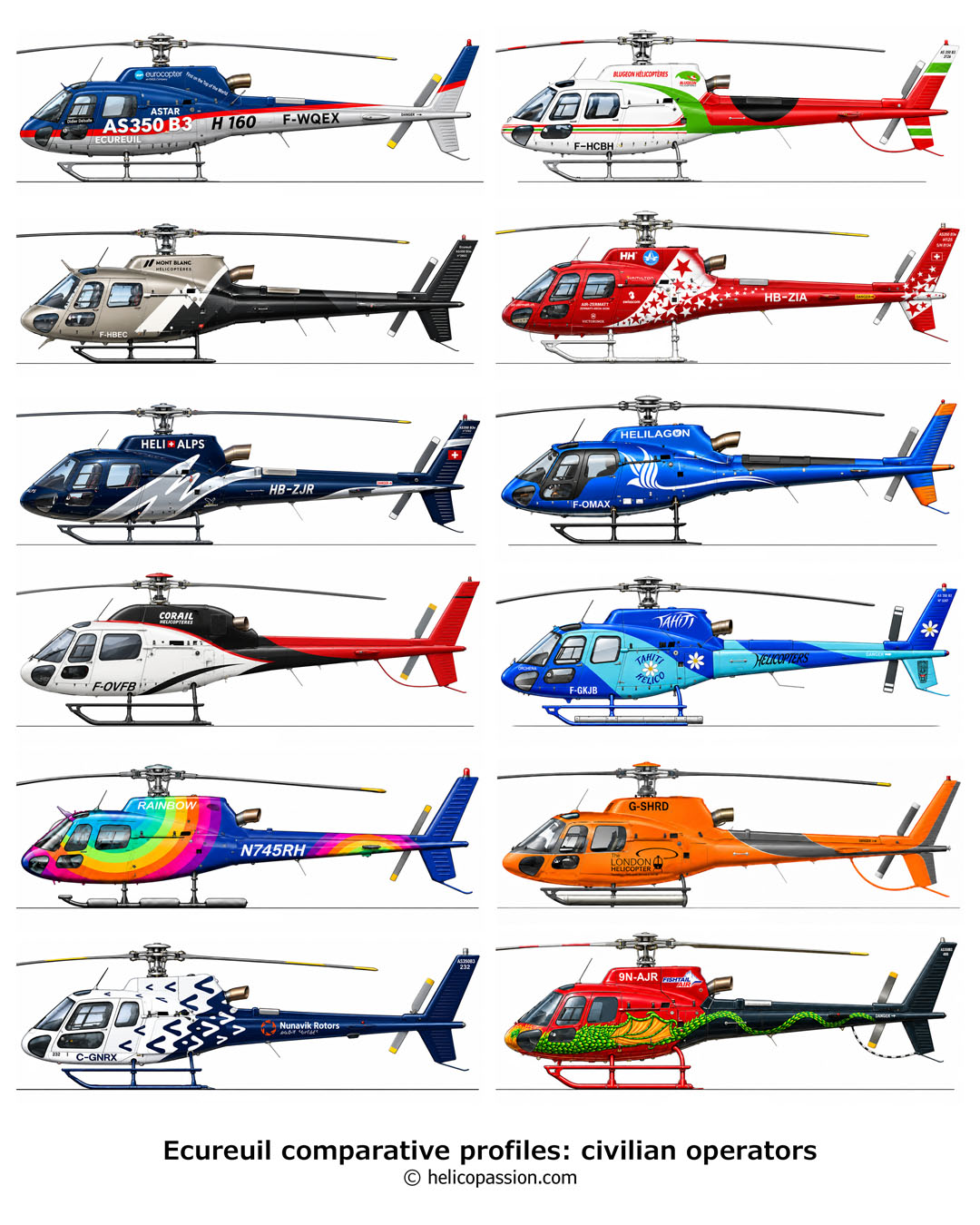
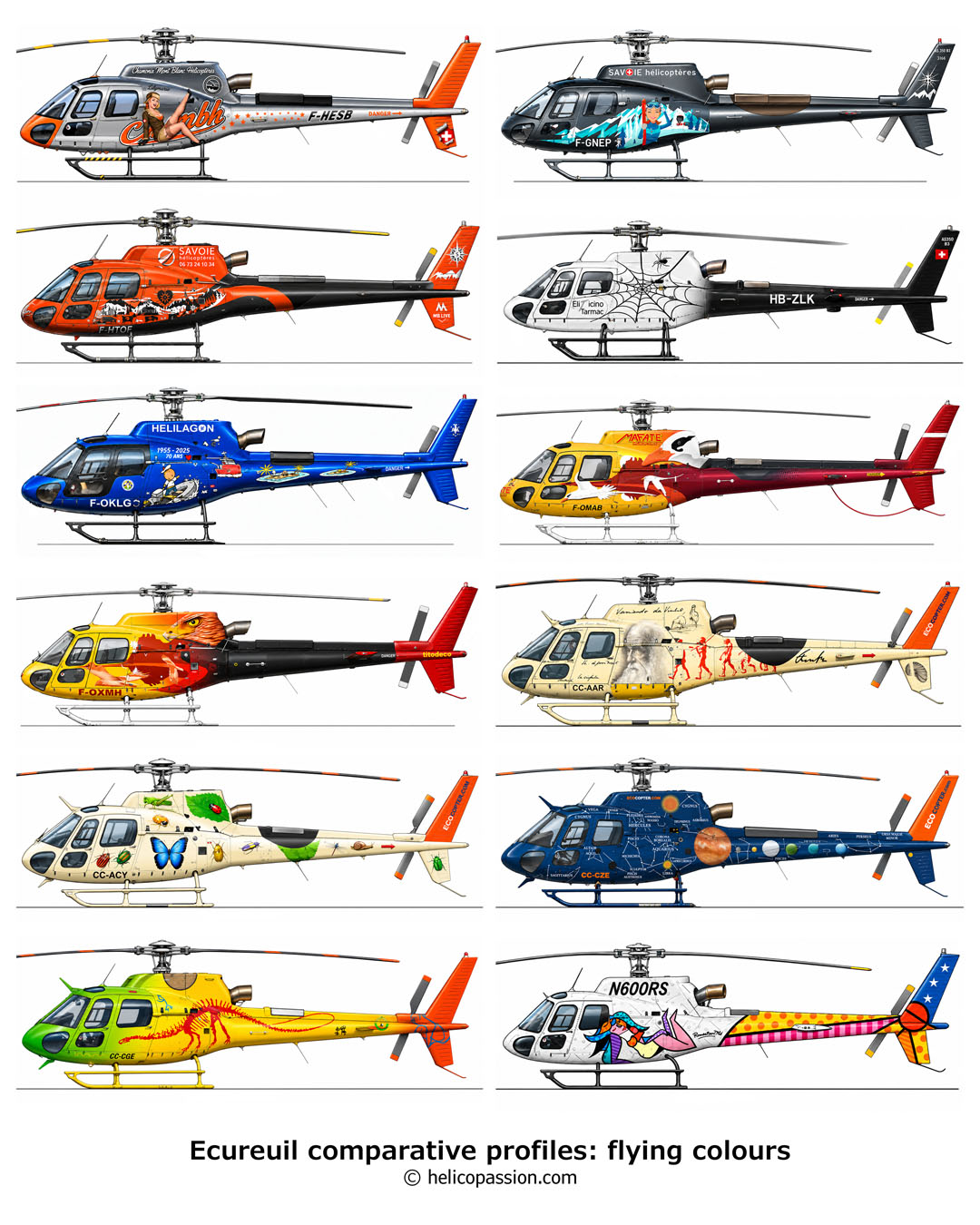
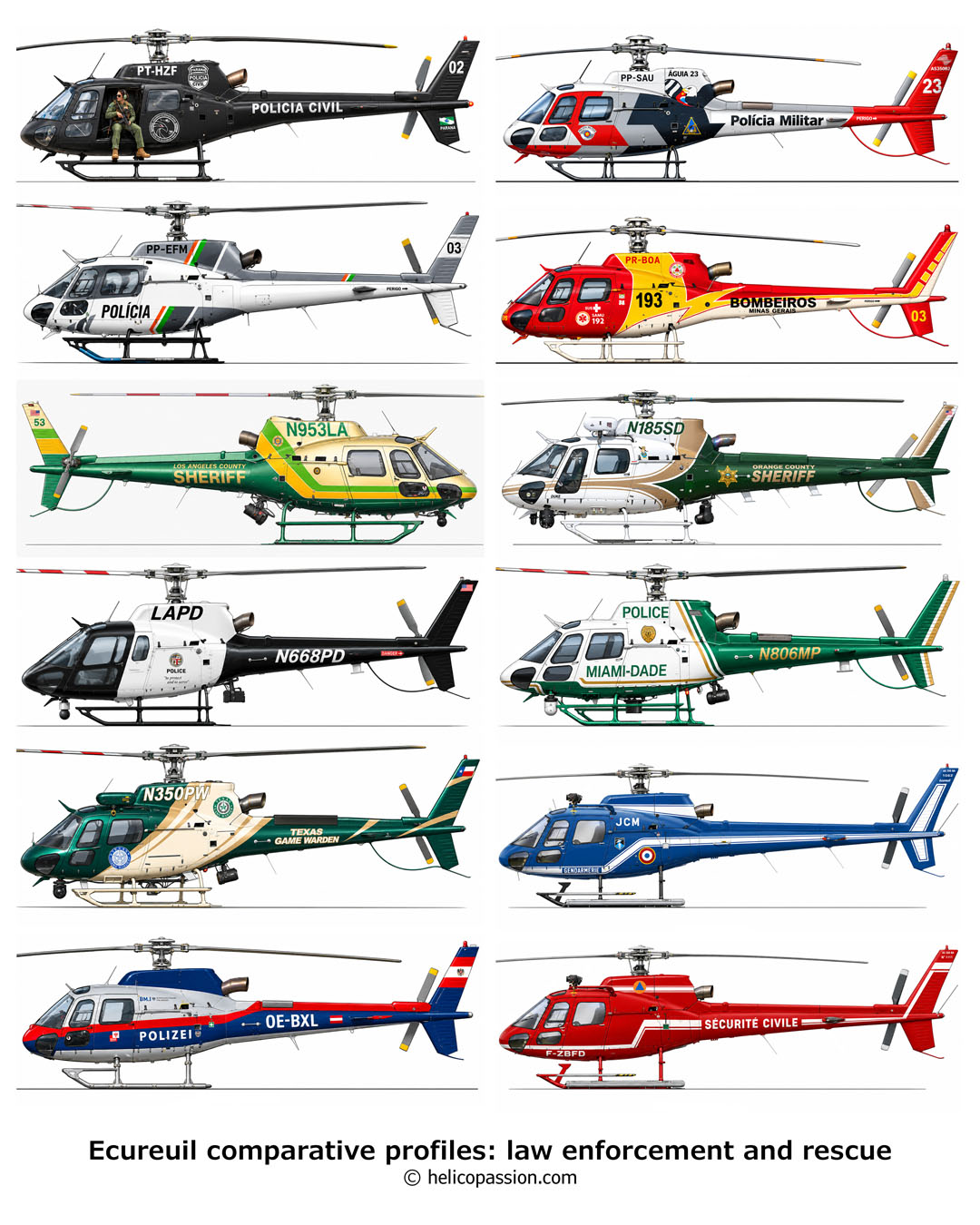
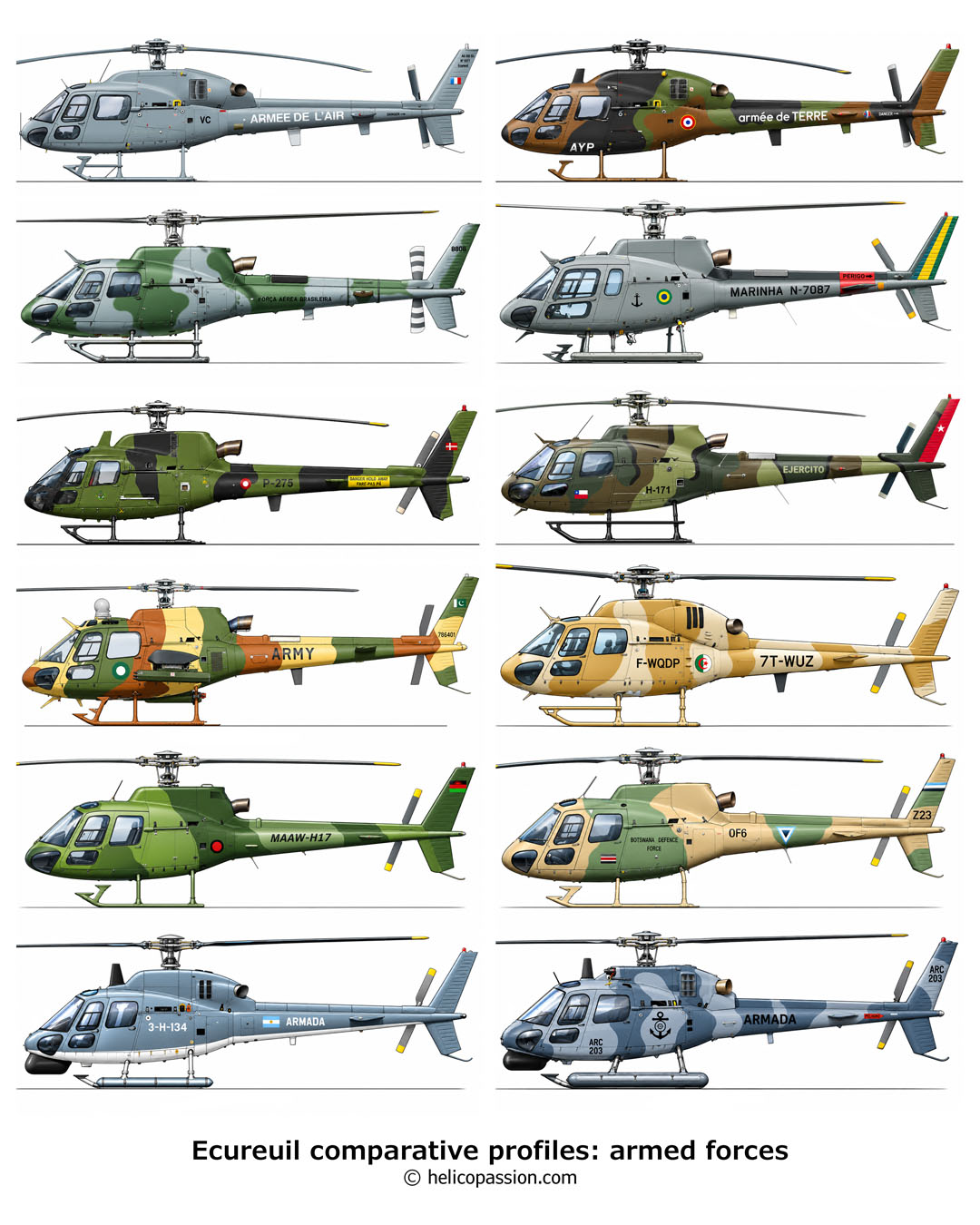
(Helicopassion side-view profiles with AI) Four comparative plates featuring 48 side-view profiles of the Ecureuil family
7. Editorial illustrations
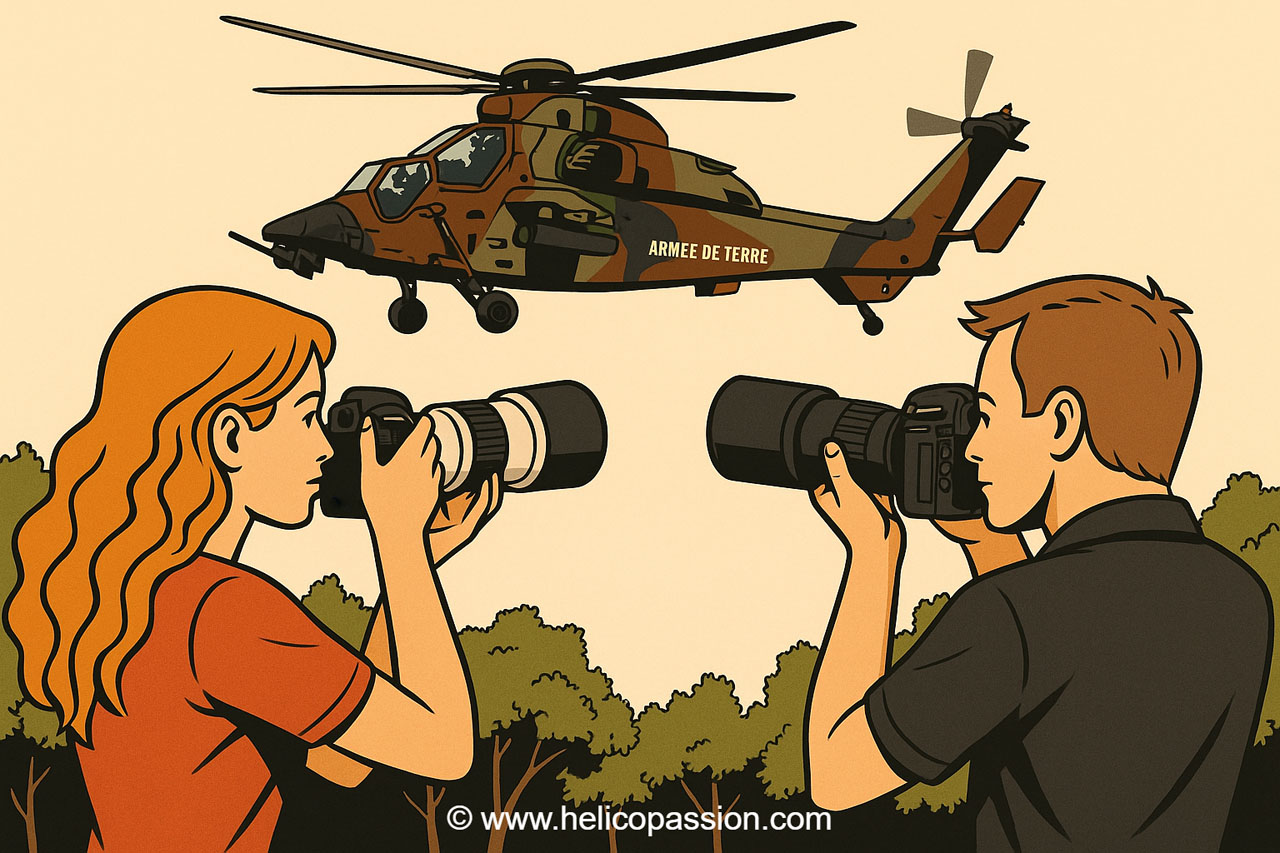
Some illustrations are created to accompany Helicopassion's guides and thematic articles. They depict activities, environments or situations characteristic of the helicopter world without necessarily referring to a specific event.
 (Helicopassion illustration with AI)
Illustration for the helicopter photography guide, featuring two photographers using Canon and Nikon equipment.
8. Cover illustrations
Cover illustrations for helicopter dossiers are generally based on photographs selected from field reports published on Helicopassion.
Their graphic treatment distinguishes them from the lead photographs of the original field reports and gives the dossiers a consistent visual identity. The same approach is used for guides and comparative articles, including those on first flight dates and helicopter weights.
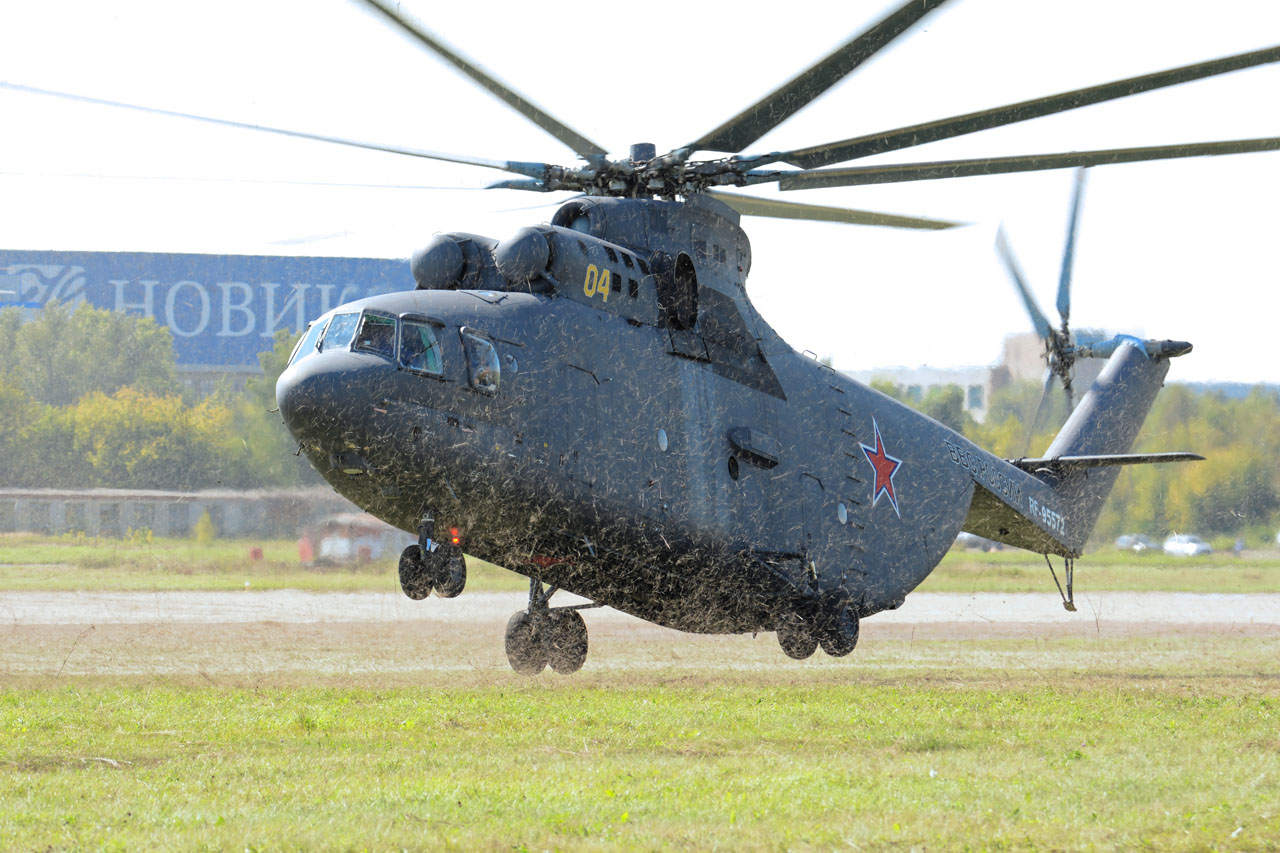 (Photo by André Bour – Helicopassion)A Russian armed forces Mi-26 landing at the MAKS 2013 air show
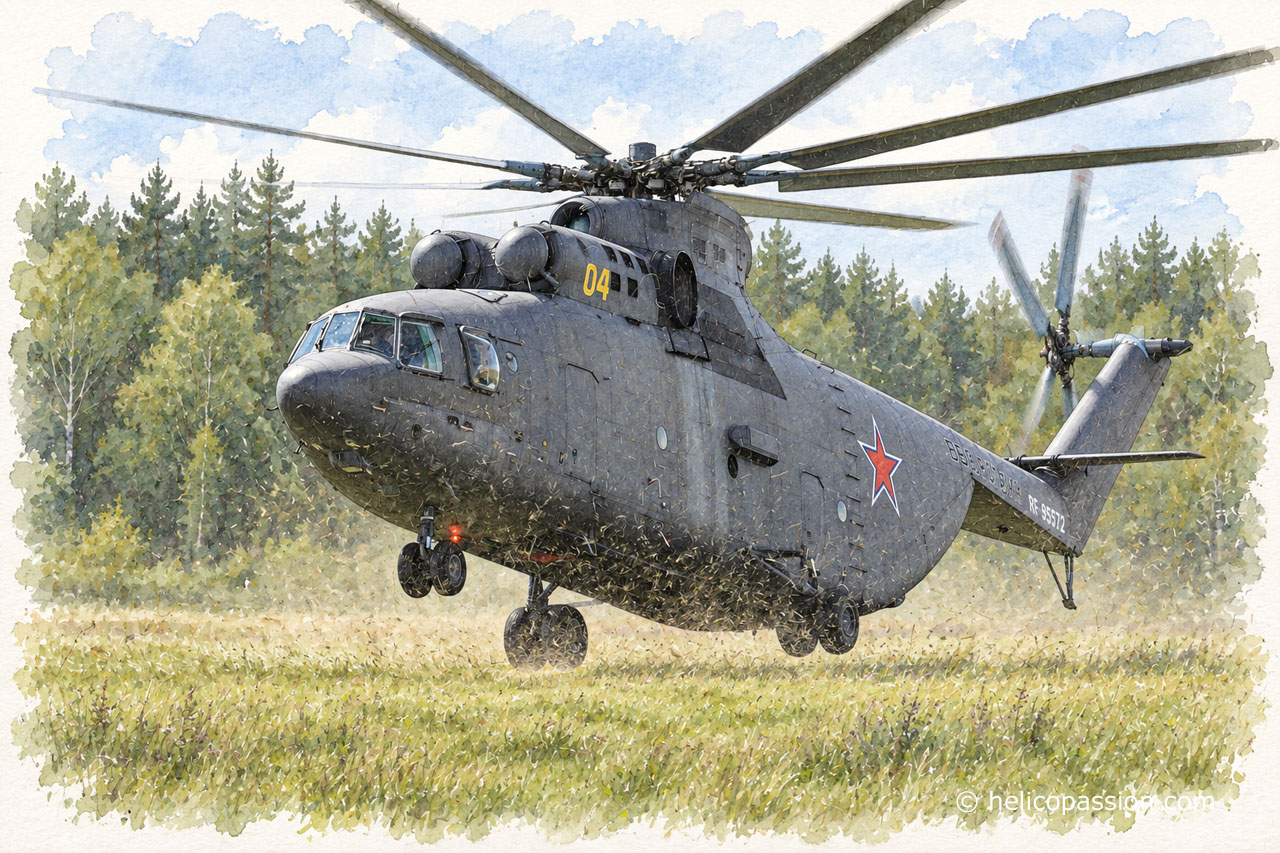 (Helicopassion illustration with AI, based on a photograph by André Bour)
Cover illustration for the Mi-26 dossier, based on this photograph with the helicopter placed in a natural setting
9. Contextual and artistic illustrations
Since its early days, Helicopassion has taken an interest in the artistic representation of helicopters. Its art gallery (in French) features works displayed with the permission of their artists, as well as illustrations created for model kit boxes and video games. These creations offer another perspective on the helicopter world, combining aviation realism, a sense of composition and artistic expression.

(Illustration by Dru Blair)
An AH-64 Apache flying over water. A remarkable depiction of movement, rotor downwash and the natural environment by artist Dru Blair
Some of these artists have themselves used Helicopassion photographs as references for their creations. Their work helped inspire the idea of creating our own artistic illustrations from our image library, drawing on the possibilities offered by new digital tools.
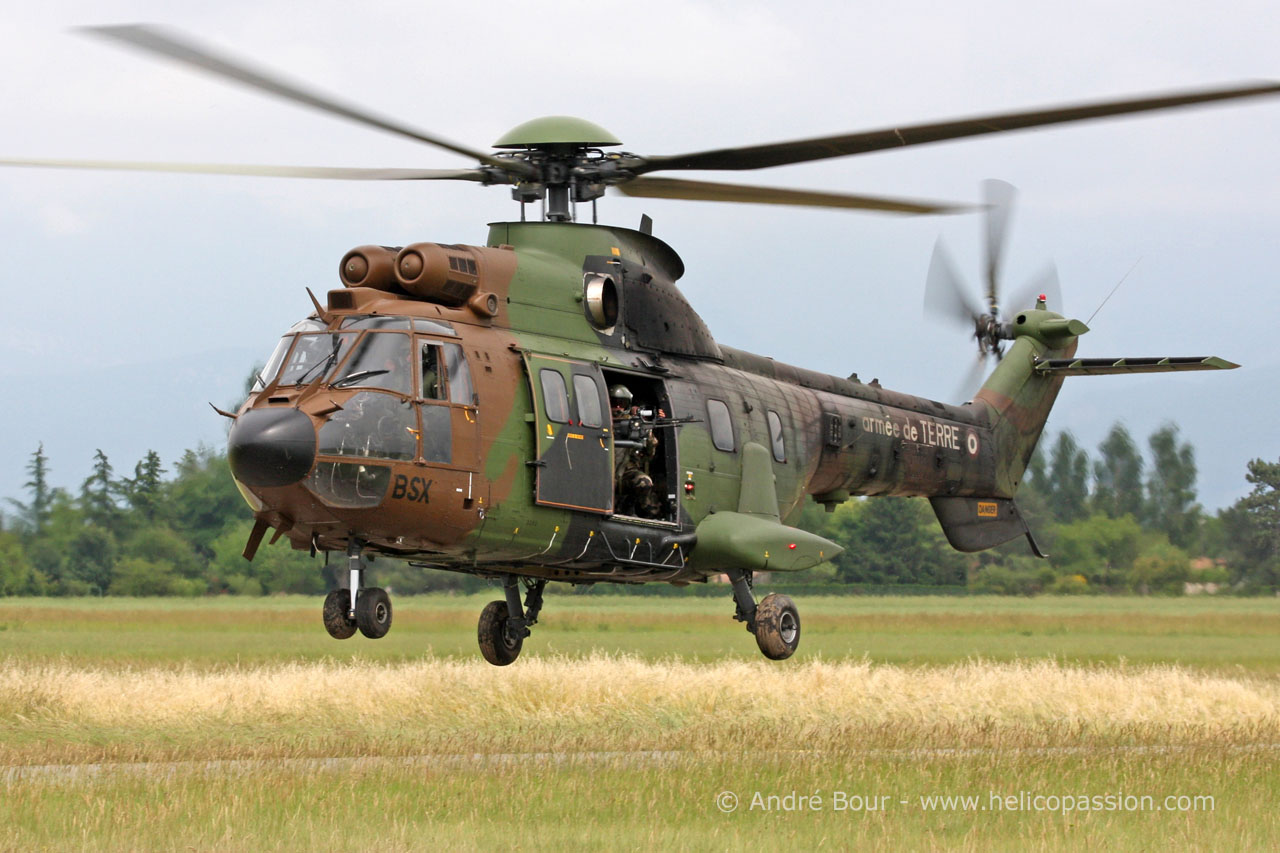 (Photo by André Bour – Helicopassion)
Original photograph of a French Army AS532 Cougar
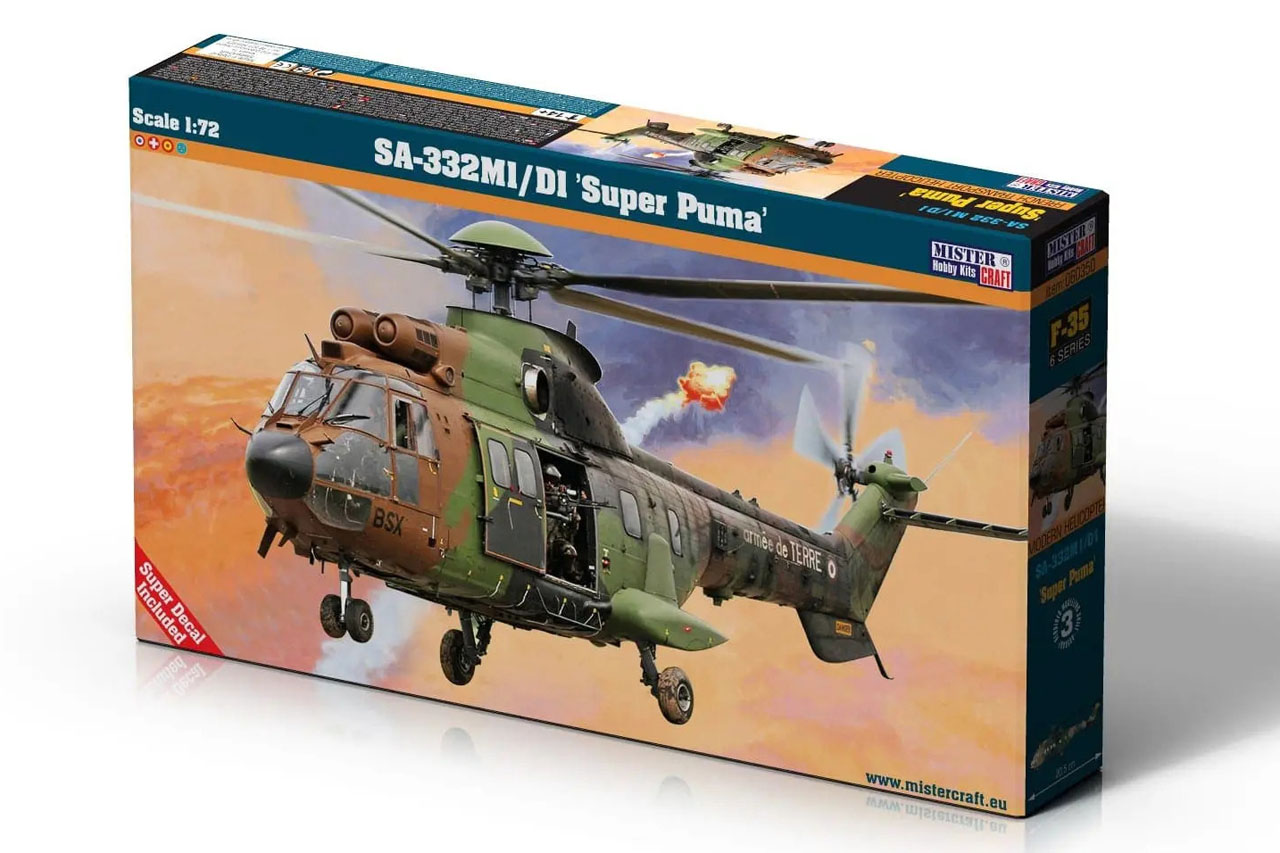 (MisterCraft illustration)
Artwork for a MisterCraft model kit box based on this Helicopassion photograph, with the aircraft placed in a combat setting
The artistic illustrations created by Helicopassion today follow the same approach: placing a helicopter in a setting evocative of its missions, whether in the mountains, an urban area, at sea or in a forest.
The process draws on digital image compositing techniques used for many years: isolating an aircraft from its background, replacing backgrounds, recreating missing or obscured elements and combining several photographs. Artificial intelligence tools now offer new ways of creating these compositions.
The aim is often to create the image we would have liked to photograph, but which would have required substantial aerial resources or difficult-to-access shooting conditions.
Unlike historical reconstructions, these compositions are not intended to depict a specific event.
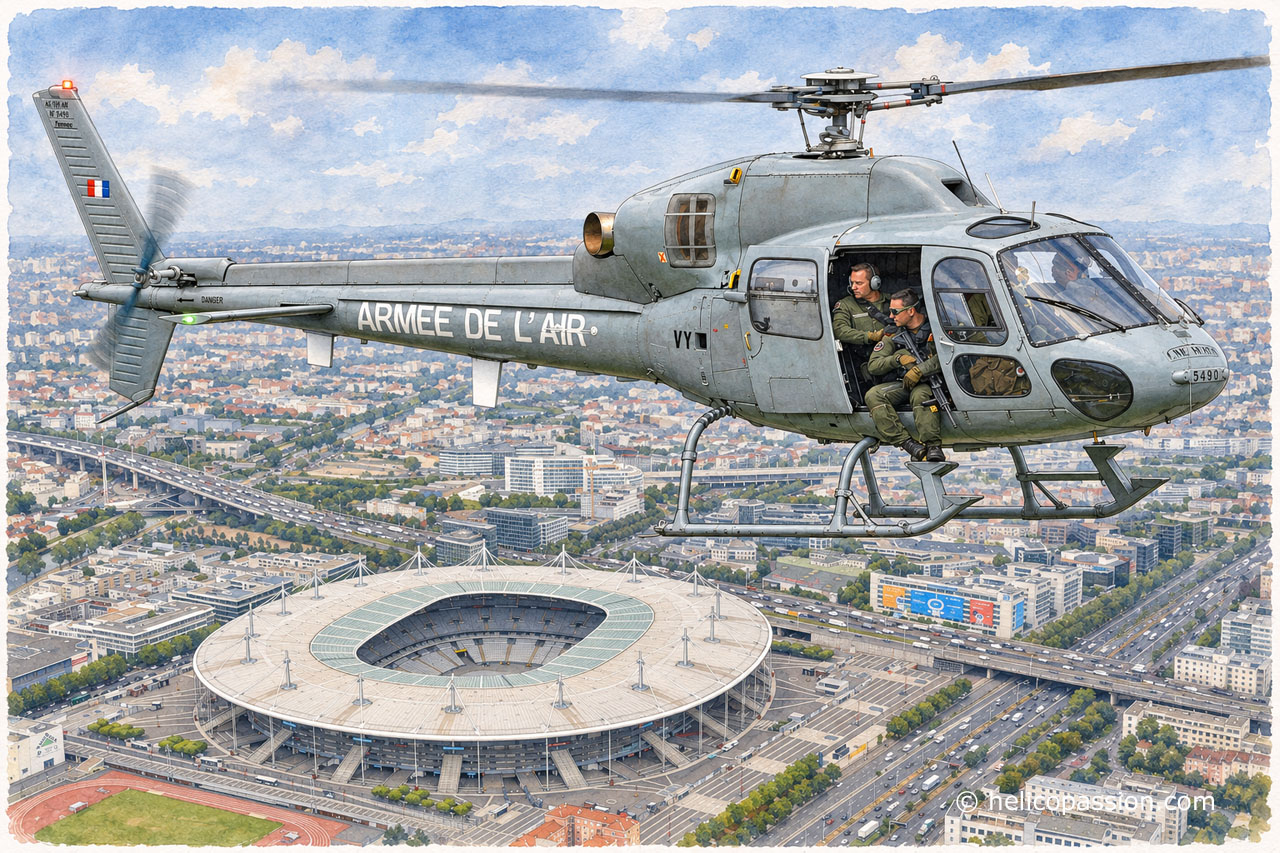 (Helicopassion illustration
with AI, based on photographs by André Bour)
A composition combining a photograph of the Fennec with an aerial view of Paris taken during the 14 July flypast. An illustration evoking the air security missions (MASA) of the French Air and Space Force.
To illustrate the missions of the Civil Police of Paraná State in Brazil, Helicopassion had a photograph of an Ecureuil helicopter in flight, with its rear section obscured by vegetation. Using other photographs of the same aircraft, an illustration was created with artificial intelligence to recreate its complete silhouette and place it in an urban setting.
 (Photo: Polícia Civil)
Reference photograph
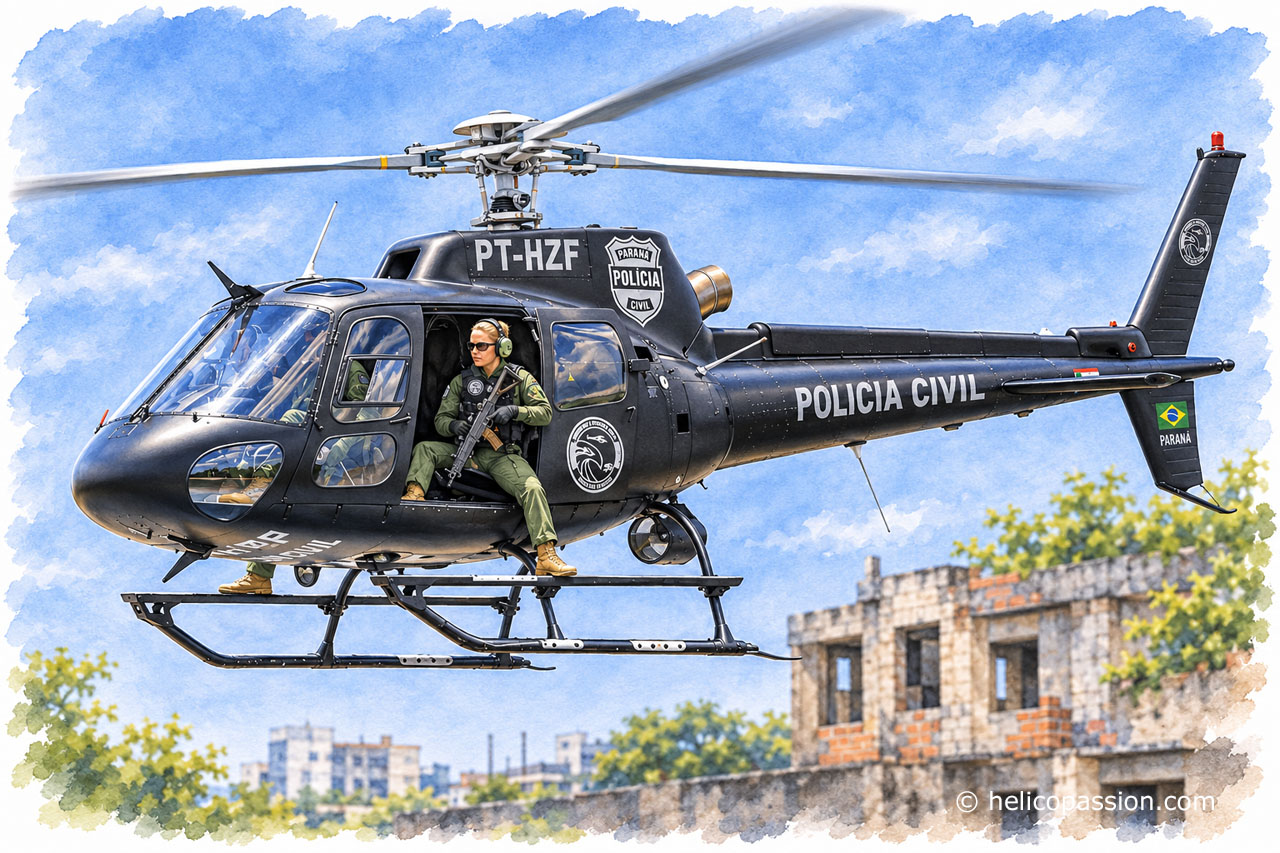 (Helicopassion illustration
with AI, based on a photograph by the Polícia Civil)
Illustration based on the photograph
10. Historical reconstructions
Historical reconstructions provide visual representations of documented events for which photographs are rare, unavailable or insufficient to understand the scene depicted.
They draw on available accounts, archival documents and photographs used to identify aircraft and their configurations.
To depict the first strikes of Operation Serval at Konna in January 2013, Helicopassion had actual photographs of the two Gazelle variants involved in the operation: a cannon-armed Gazelle and a HOT-equipped Gazelle. These references made it possible to place the aircraft in a scene reconstructed from the documented account of the engagement.
 (Photo by André Bour – Helicopassion)
Gazelle equipped with HOT missiles
 (Photo by André Bour – Helicopassion)
Gazelle equipped with a 20 mm cannon
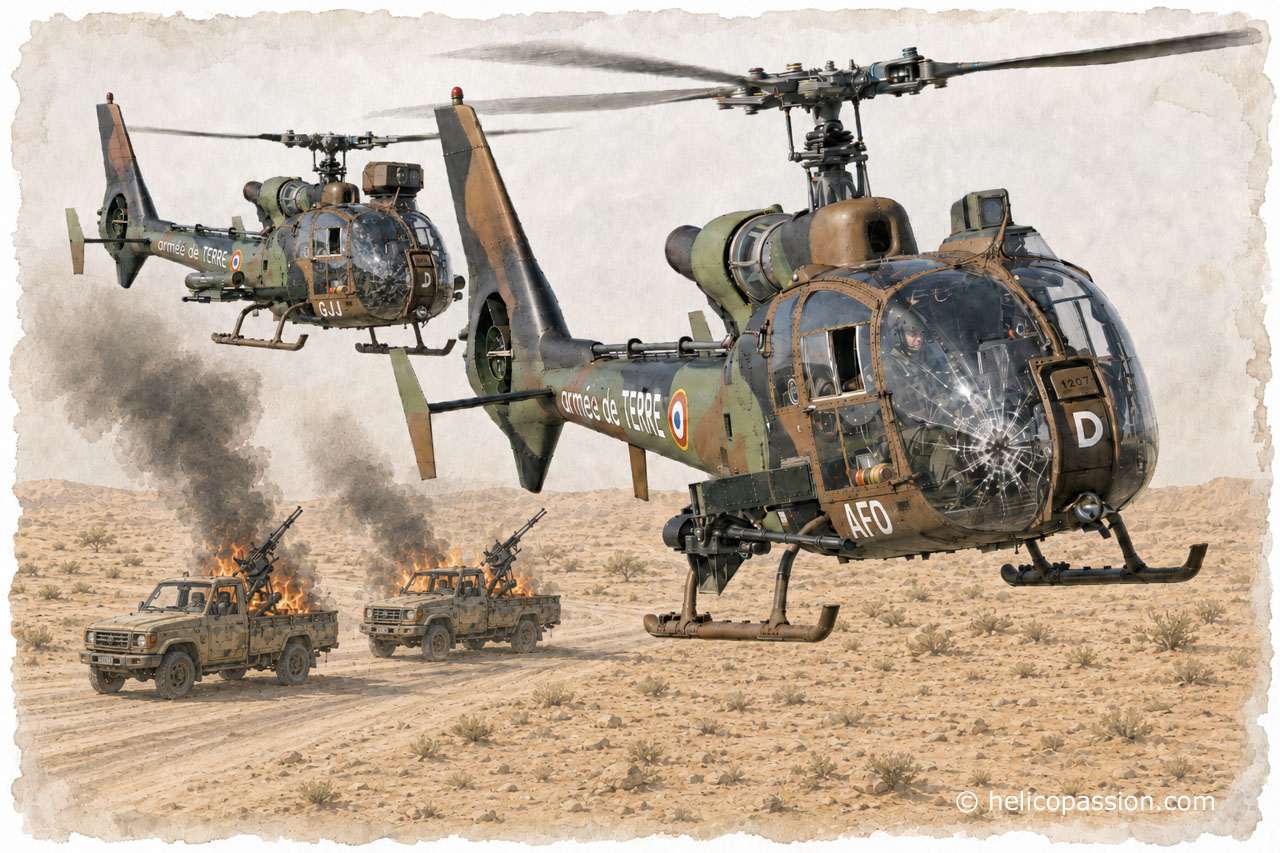 (Helicopassion historical reconstruction with AI, based on photographs by André Bour)
Reconstruction of the first strikes of Operation Serval at Konna in January 2013
Helicopassion illustration gallery
A selection of illustrations created for Helicopassion's dossiers, guides and articles, reflecting the diversity of the subjects documented and the possibilities of visual representation.
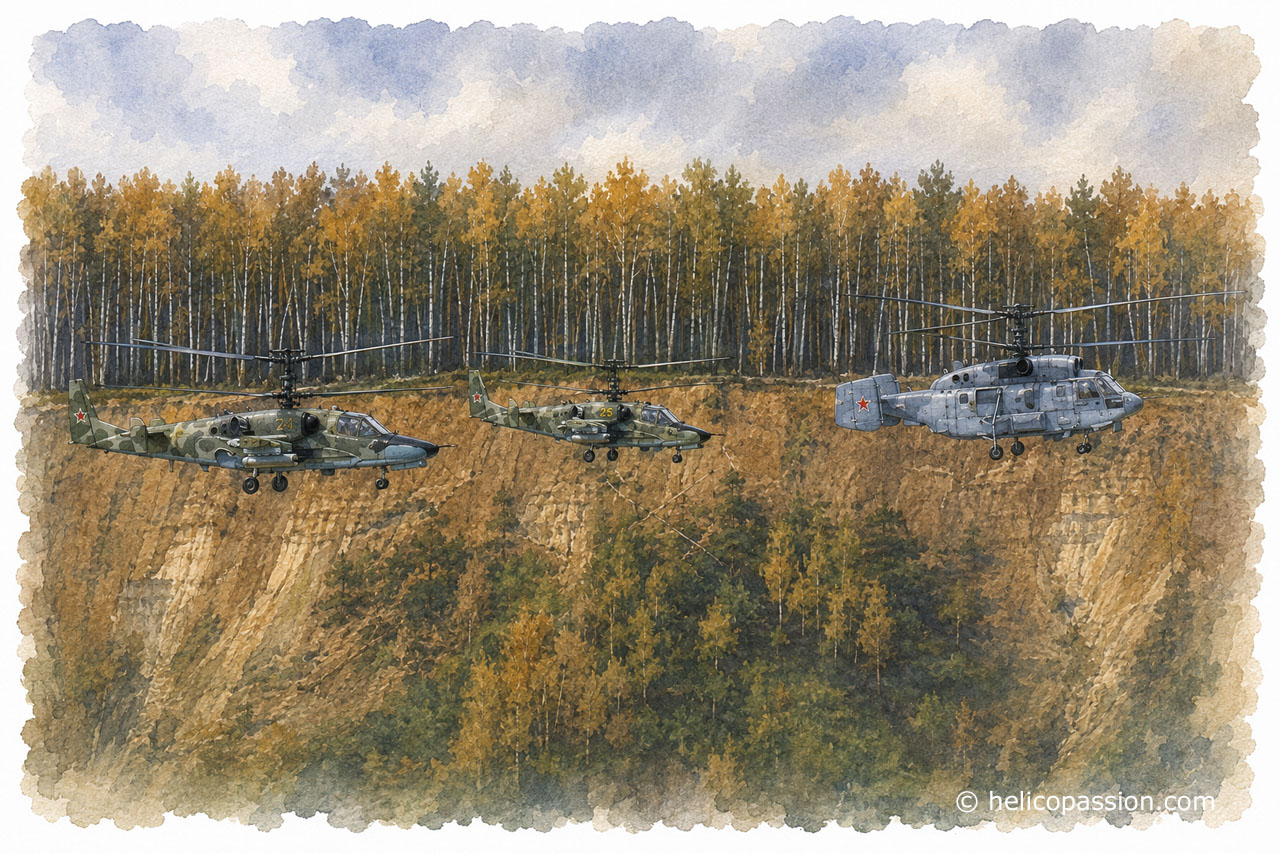 (Helicopassion historical reconstruction with AI, based on an archival photograph)
The BUG group flying in Chechnya: two Ka-50 Black Sharks preceded by a Ka-29 target designation helicopter
See the Ka-50 in Chechnya (in French)
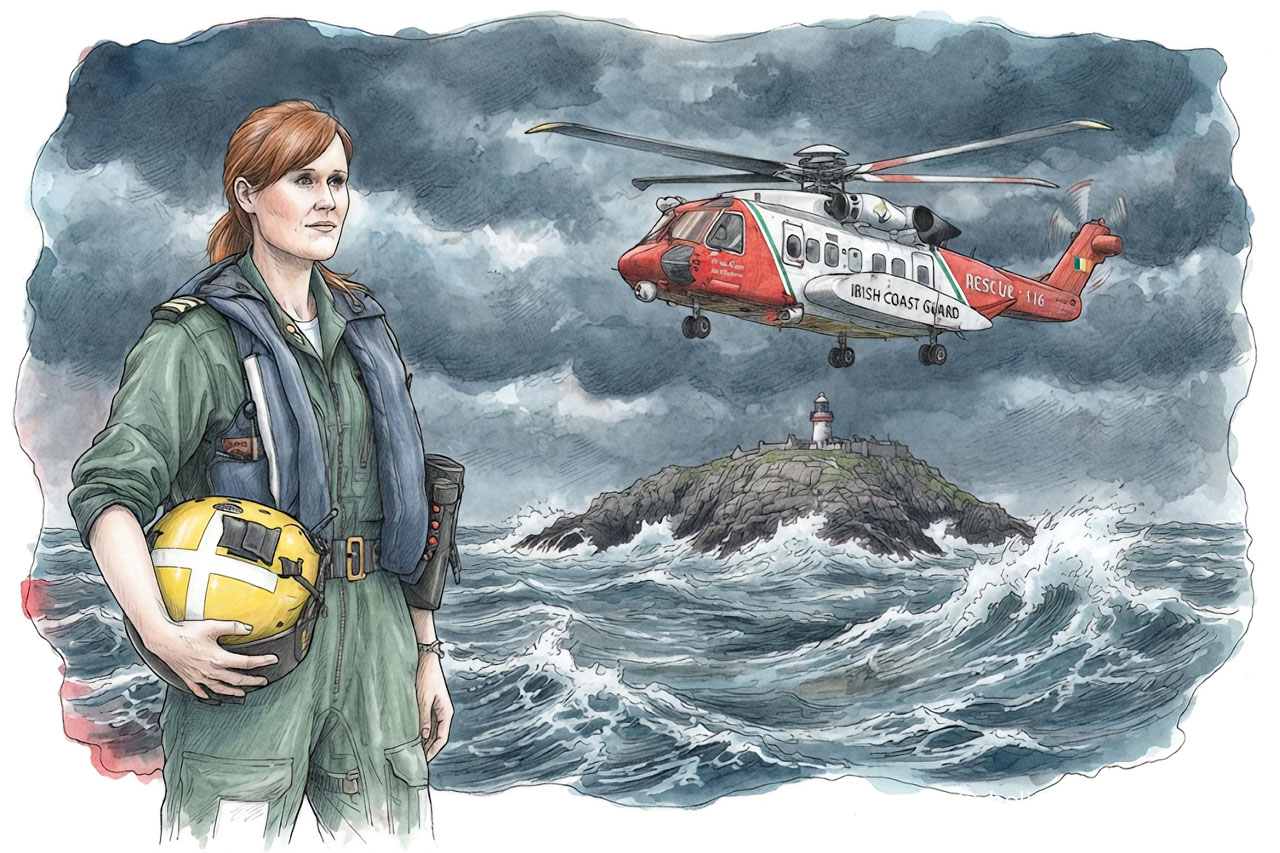
(Helicopassion historical reconstruction with AI)
Captain Dara Fitzpatrick, Rescue 116 and Black Rock island
See the Sikorsky S-92 dossier (in French)
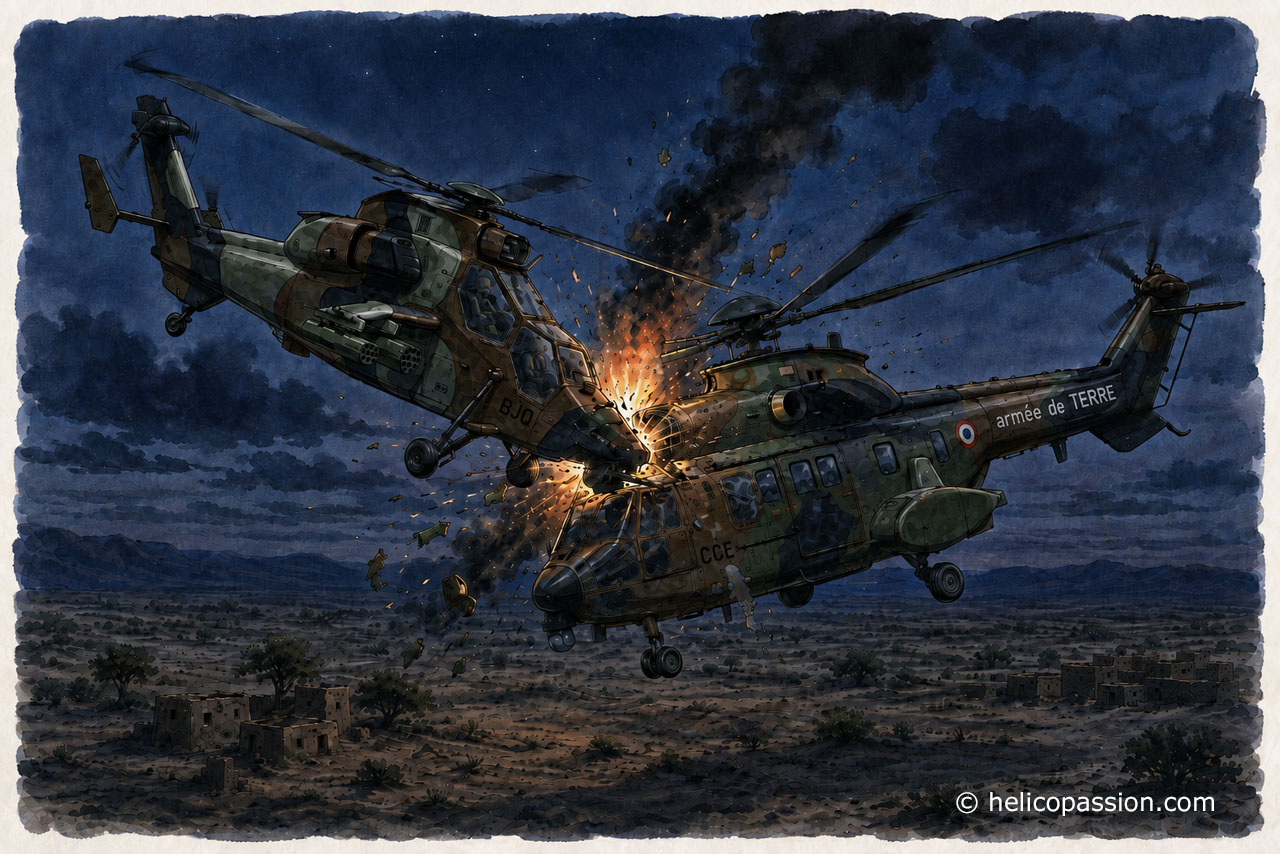
(Helicopassion historical reconstruction with AI)
25 November 2019: mid-air collision between Cougar CGE and Tiger BJQ in the Eranga valley, Mali. See the Puma, Cougar and Caracal dossier (in French)
(Helicopassion historical reconstruction with AI)
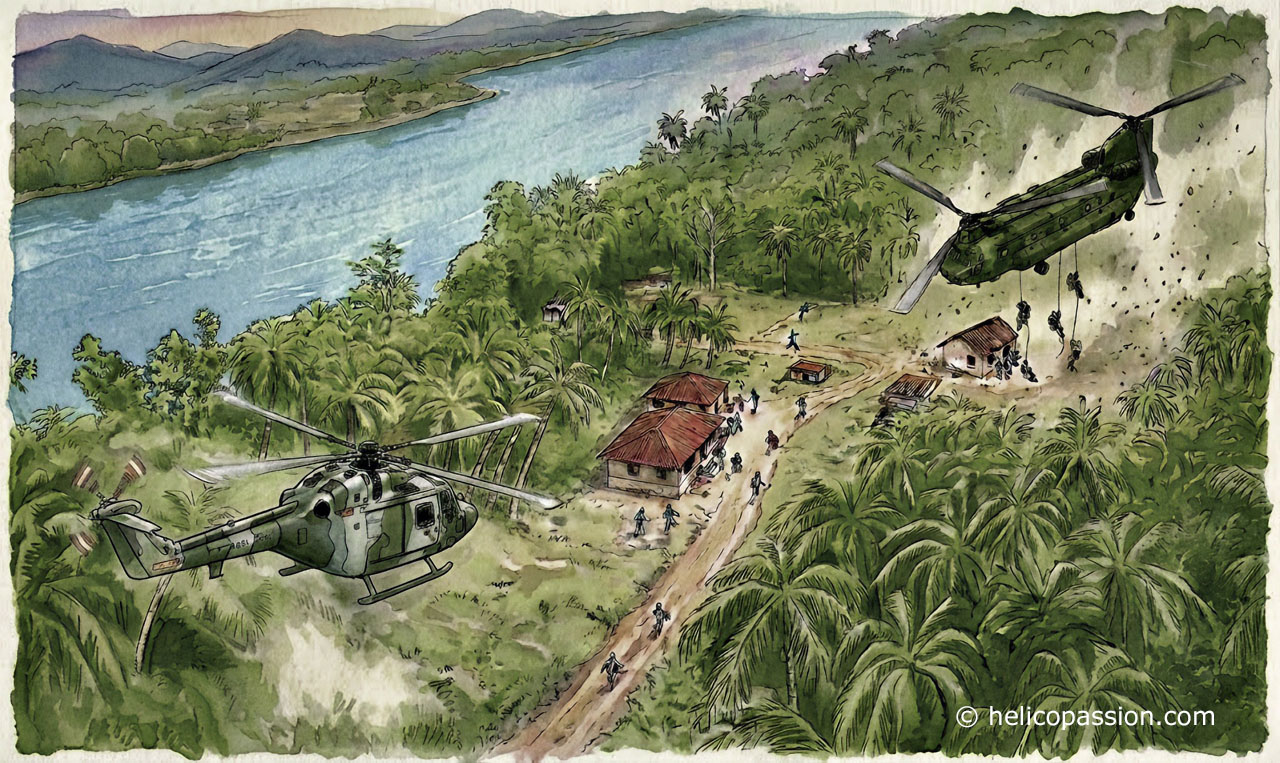
Fast-roping from a Chinook helicopter at Rokel Creek, with a Lynx providing fire support See the Boeing CH-47 Chinook dossier (in French)
(Helicopassion historical reconstruction with AI)
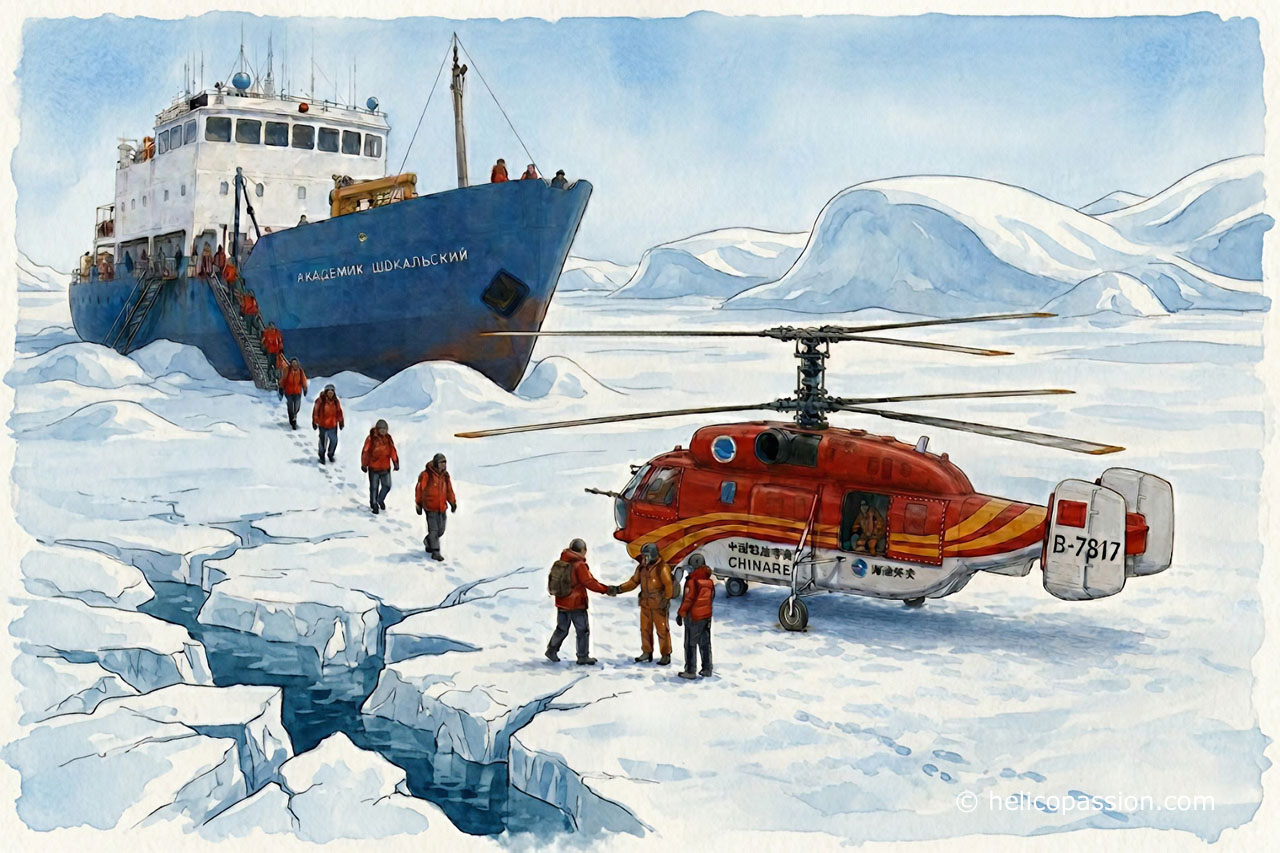
In January 2014, Kamov Ka-32A11BC B-7817 “Snow Eagle 12”, operating from the Chinese icebreaker Xue Long, evacuated passengers from the Akademik Chokalskiy, trapped in Antarctic ice
See the Kamov Ka-27, Ka-29 and Ka-32 Helix dossier (in French)
(Helicopassion illustration with AI)
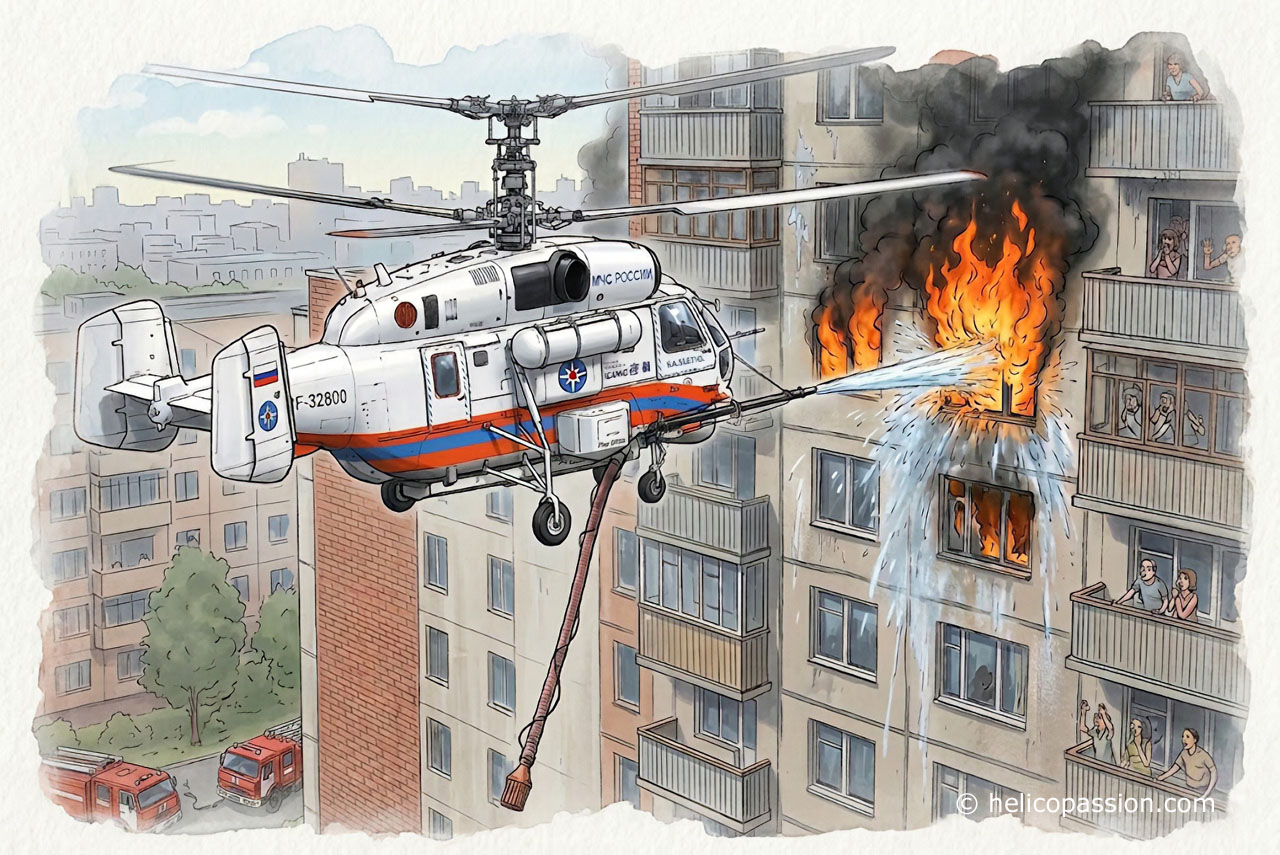
A Ka-32 helicopter using its water cannon to tackle an urban fire
See the Kamov Ka-27, Ka-29 and Ka-32 Helix dossier (in French)
 (Helicopassion illustration with AI, based on an archival photograph)
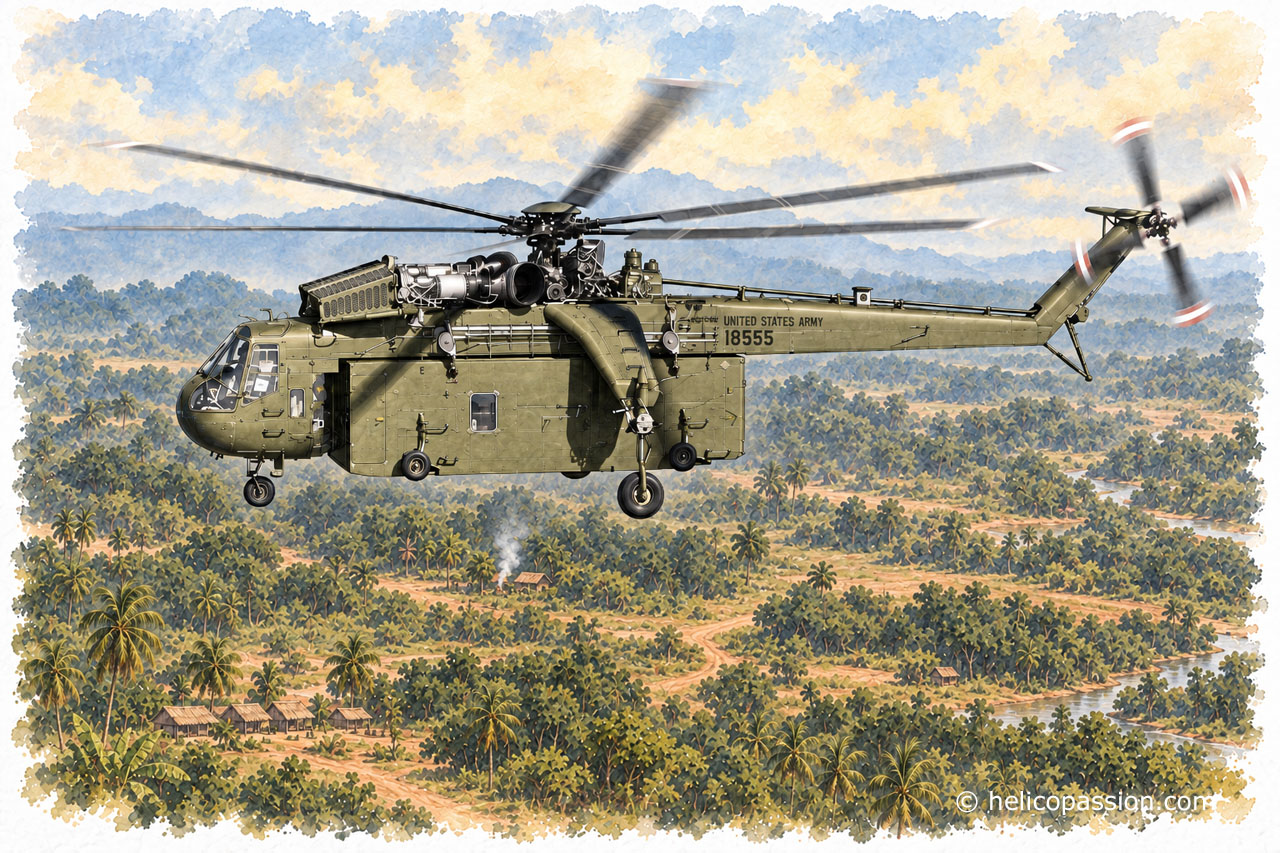
The CH-54 Skycrane fitted with a Universal Military Pod
See the Sikorsky CH-54 Skycrane / S-64 Air Crane dossier (in French)
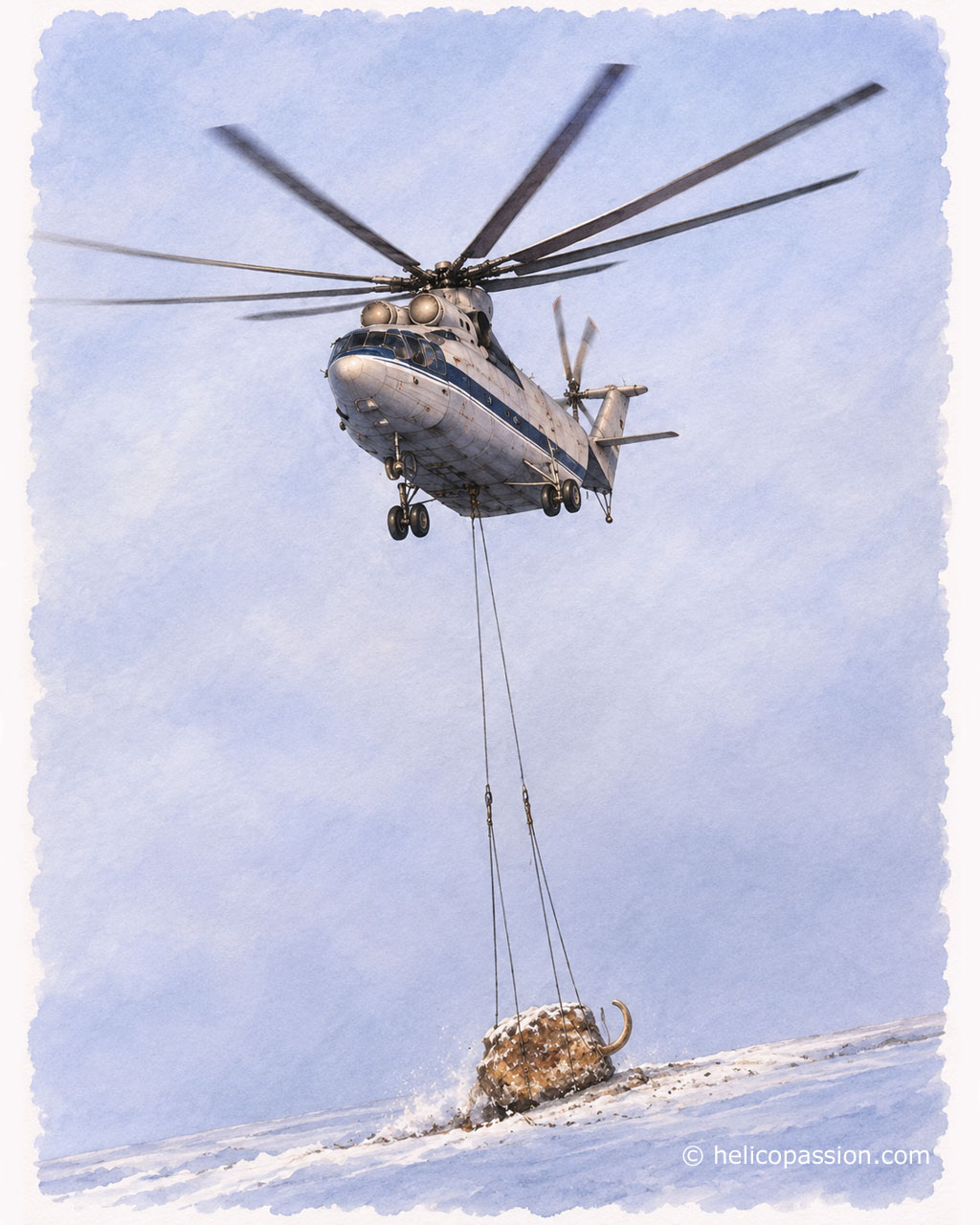 (Helicopassion historical reconstruction with AI, based on archival photographs) 17 October 1999: a Mi-26 lifts a 23-tonne block of Siberian permafrost containing the remains of the Jarkov mammoth. The load exceeds the helicopter's nominal underslung load capacity by 3 tonnes See the Mi-26 Halo dossier (in French)
Helicopassion Visual Collections
The photographs, side-view profiles, artistic illustrations and historical reconstructions created for selected dossiers are also brought together in the Helicopassion Visual Collections (in French). These visual collections offer another way to browse, compare and keep this documentation.