Mil Mi-26 Halo, the world's largest helicopter
Photographic series, comparative profiles, historical reconstructions and remarkable missions.
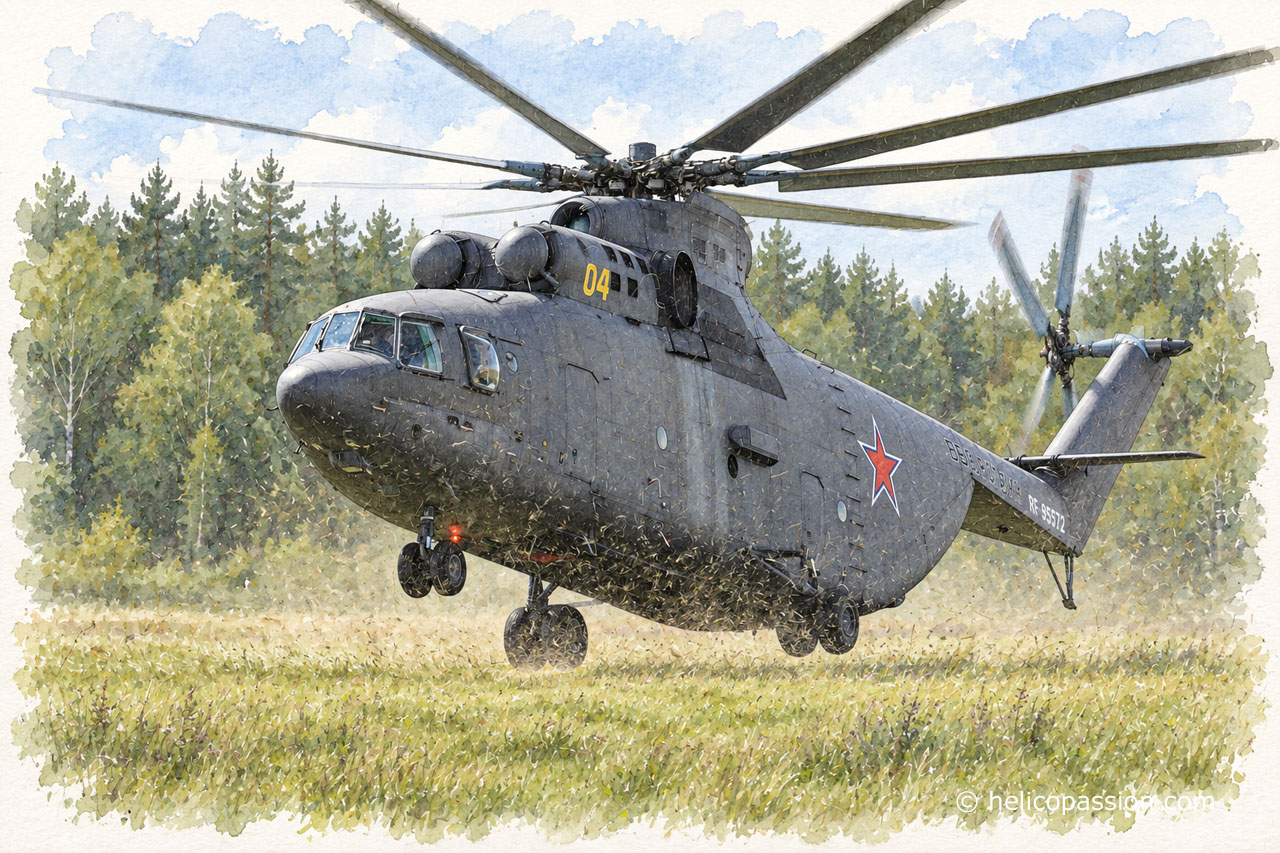 (Helicopassion iIllustration with AI, based on a photograph by André Bour)
A Russian Armed Forces Mi-26 in a grey colour scheme lands in front of us, kicking up a cloud of grass in its rotor wash. Original photograph taken at MAKS 2013.
The Mil Mi-26 Halo is the world's largest helicopter. With an eight-bladed main rotor measuring 32 metres in diameter and a lifting capacity of up to 20 tonnes, it was developed to transport exceptionally heavy and bulky loads.
Designed in the Soviet Union as a successor to the Mi-6 Hook, the Mi-26 made its first flight on 14 December 1977 and entered service in 1983. Built by Rostvertol, it has been used by armed forces, commercial operators and emergency services around the world.
Its cargo compartment is comparable in size to that of a C-130 Hercules or Transall transport aircraft. Yet its most remarkable capability is the ability to carry heavy loads beneath the helicopter, reaching locations inaccessible by conventional transport.
This Helicopassion feature combines original aviation photography, comparative profiles and illustrated historical events with a concise overview of the Mi-26's development, operators and exceptional missions.
Development, modernisation and operational challenges
The original Mi-26 was designed around a five-person crew, with separate positions for pilots, a navigator, a flight engineer and a load operator.
The Mi-26T2 introduced a major modernisation of the cockpit. Announced in 2008 and first flown in February 2011, it features five multifunction displays, digital avionics and increased automation. Routine operations can be conducted by two pilots, with an additional operator for external-load missions.
Despite its exceptional capabilities, keeping the Mi-26 airworthy is a demanding undertaking. Its engines, transmission and enormous rotor system require specialised maintenance, while ageing airframes and major overhauls can result in prolonged periods of inactivity.
The helicopter's industrial future has also been affected by the deterioration of relations between Russia and Ukraine. Its D-136 engines were developed and manufactured in Ukraine, and cooperation was disrupted after 2014, particularly following Russia's invasion of Ukraine in 2022. Russia is developing a replacement engine, but regular production of new Mi-26 helicopters remained unconfirmed in 2026.
Mi-26 photographic series: Venezuela & UTair
Two original photographs introduce the diversity of Mi-26 operations, from military aviation in South America to heavy-lift transport in the remote regions of Canada.
Venezuelan Army
Venezuela acquired three Mi-26T helicopters in 2005 to reinforce its military heavy-lift capabilities.
The Mi-26 can transport troops, vehicles and bulky equipment, offering a particularly valuable capability in regions where ground access is difficult.
 (Photo Ivan Pena Nesbit)
Venezuelan Army Mi-26T
UTair — Canada, 2007
UTair inherited decades of Soviet heavy-lift experience through Aeroflot and TyumenAviaTrans.
In 2007, Mi-26T RA-06297 was photographed by Jeffrey Wilson during operations associated with the NovaGold mining project near Bob Quinn Lake in British Columbia.
The previous year, the same helicopter had been involved in transporting a dismantled excavator to the Diavik diamond mine in Canada's Northwest Territories.
These operations illustrate the value of the Mi-26 for industrial projects in isolated regions.
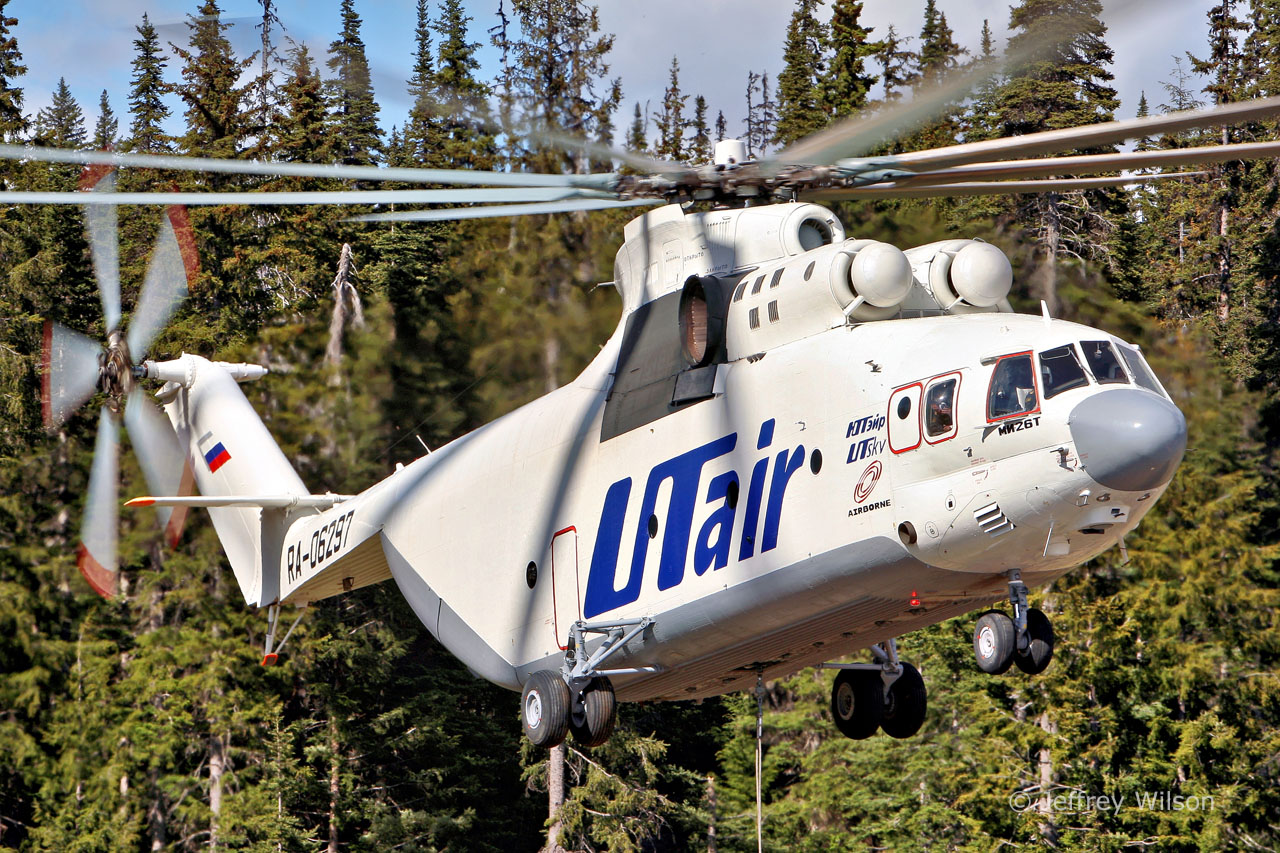 (Photo Jeffrey Wilson)
UTair Mi-26T RA-06297 during operations in British Columbia, Canada, 2007
Mi-26 comparative profiles
The Mi-26 has served a remarkable variety of operators. The following comparative profiles bring together military and civilian liveries, showing how the same heavy-lift helicopter has been adapted to very different organisations and missions.
Military operators
Developed for the Soviet armed forces, the Mi-26 subsequently entered service with the Russian military and several foreign operators.
Its principal military roles include transporting personnel, heavy equipment, vehicles and logistical supplies.
Among the countries that have operated the Mi-26 are Algeria, India, Jordan and Venezuela. Their different colour schemes and national markings are represented in the comparative profiles.
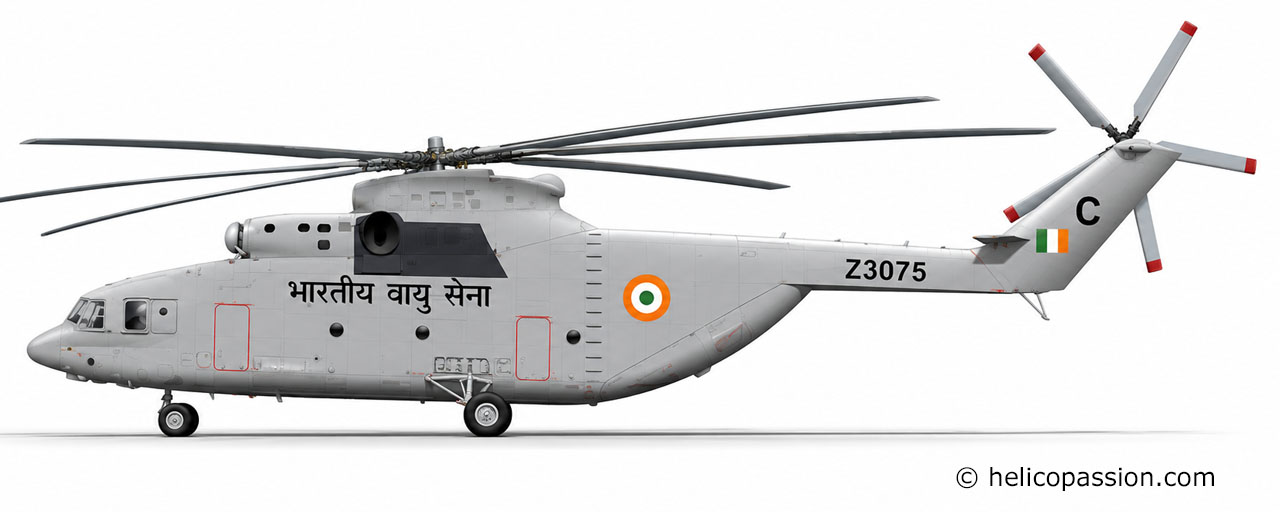 (Helicopassion illustration with AI)
India — Indian Air Force, Mi-26, Z-3075
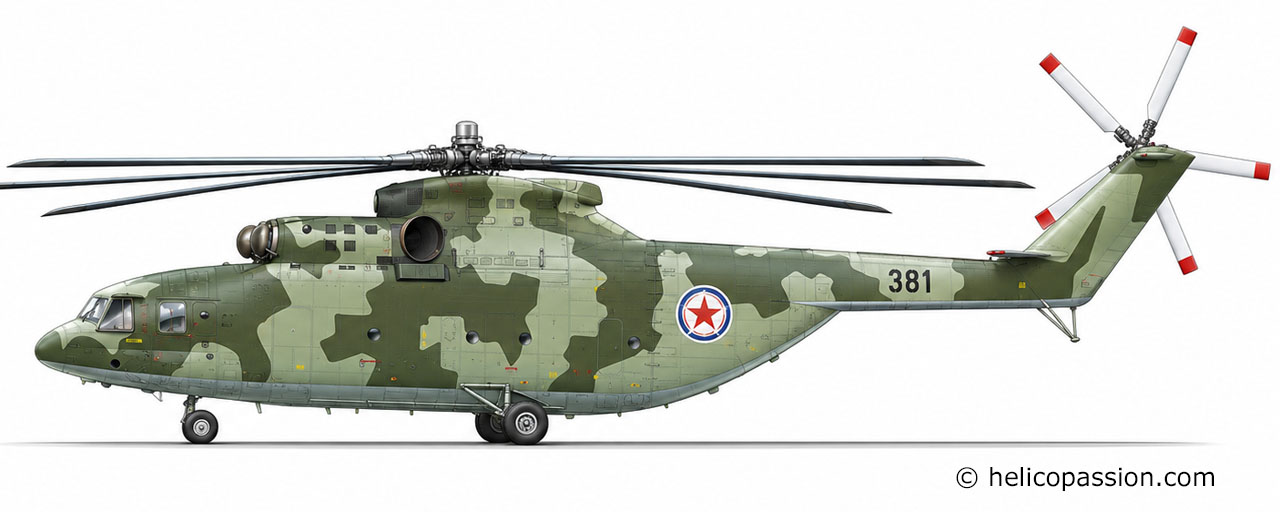 (Helicopassion illustration with AI)
North Korea — Air Force, Mi-26, No. 381
 (Helicopassion illustration with AI)
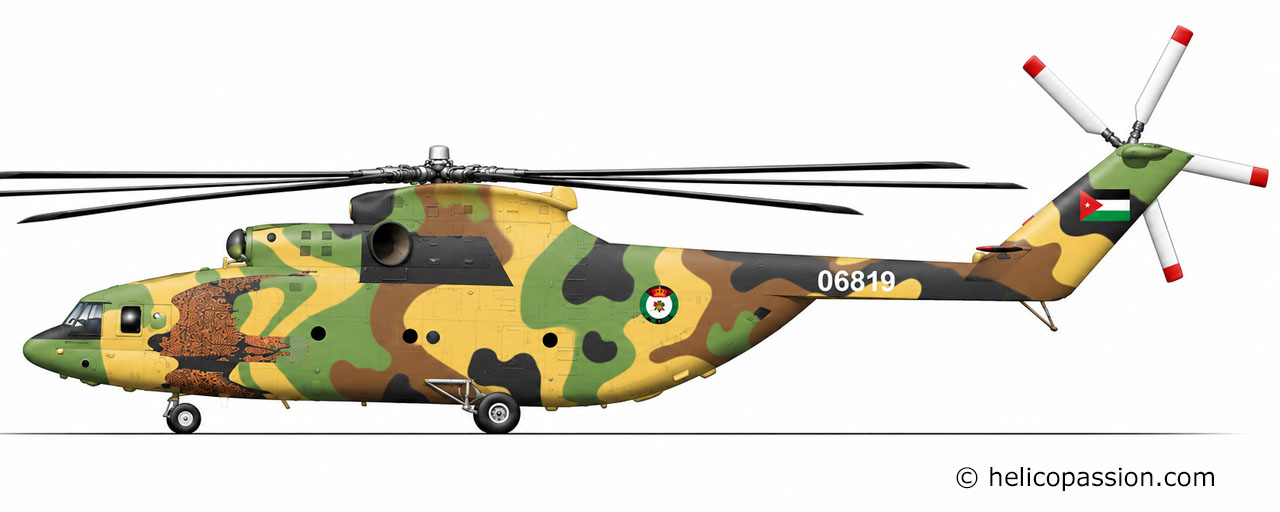
Jordan — Royal Jordanian Air Force, Mi-26T2
 (Helicopassion illustration with AI)
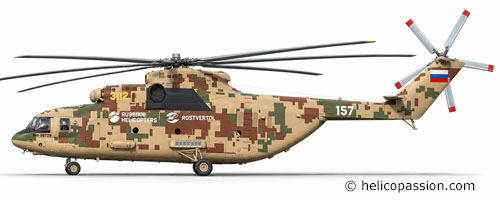
Russia — Mil demonstrator, Mi-26T2, digital camouflage
 (Helicopassion illustration with AI)
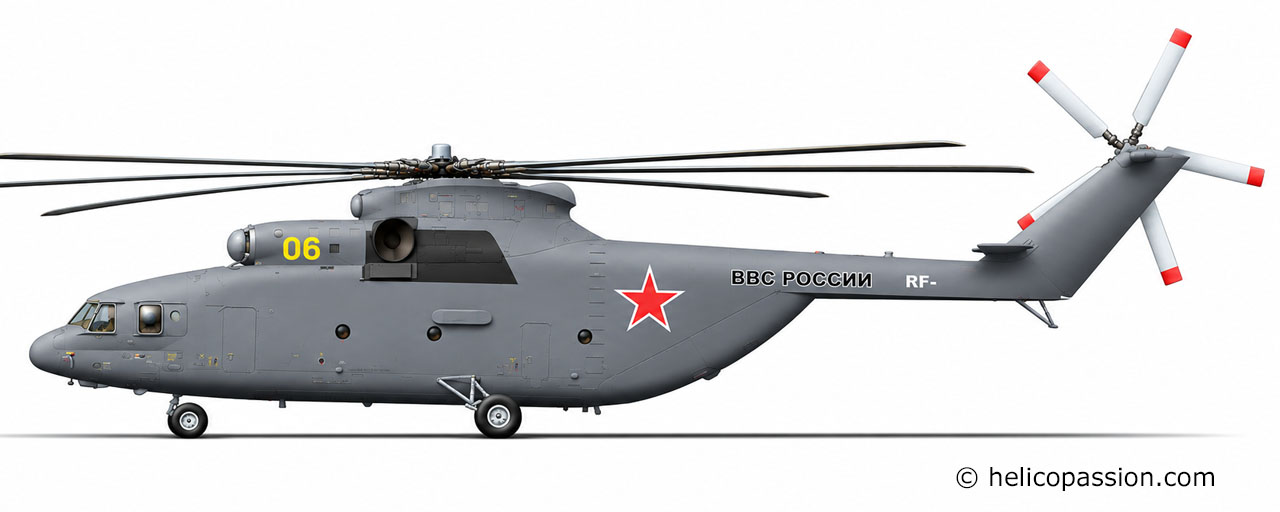
Russia — Armed Forces, Mi-26, No. 06
 (Helicopassion illustration with AI)
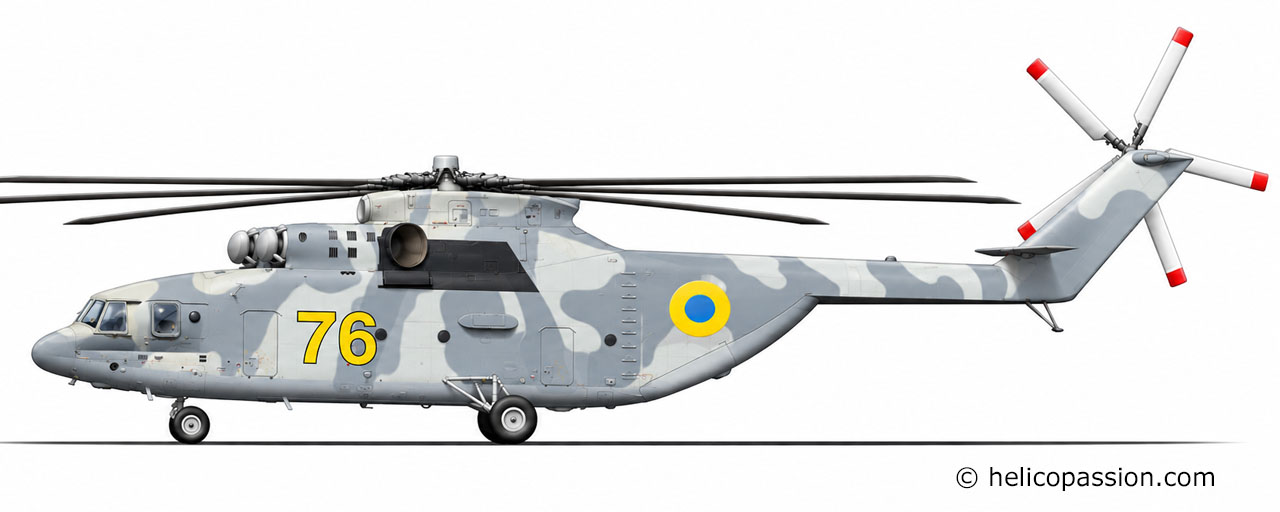
Ukraine — Mi-26, No. 76
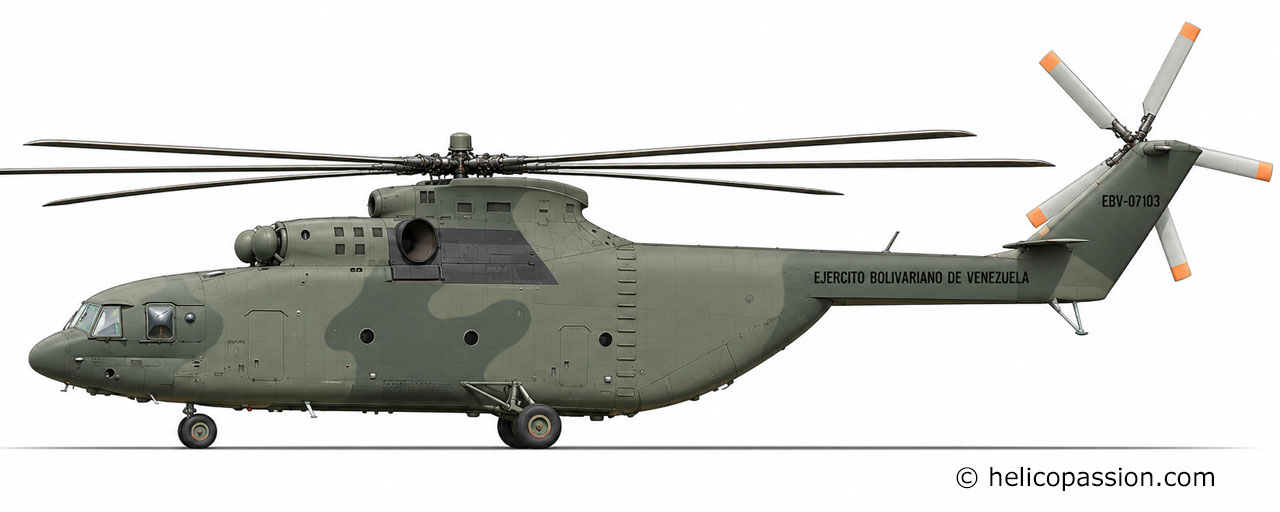 (Helicopassion illustration with AI)
Venezuela — Army Aviation, Mi-26T, EBV-07103
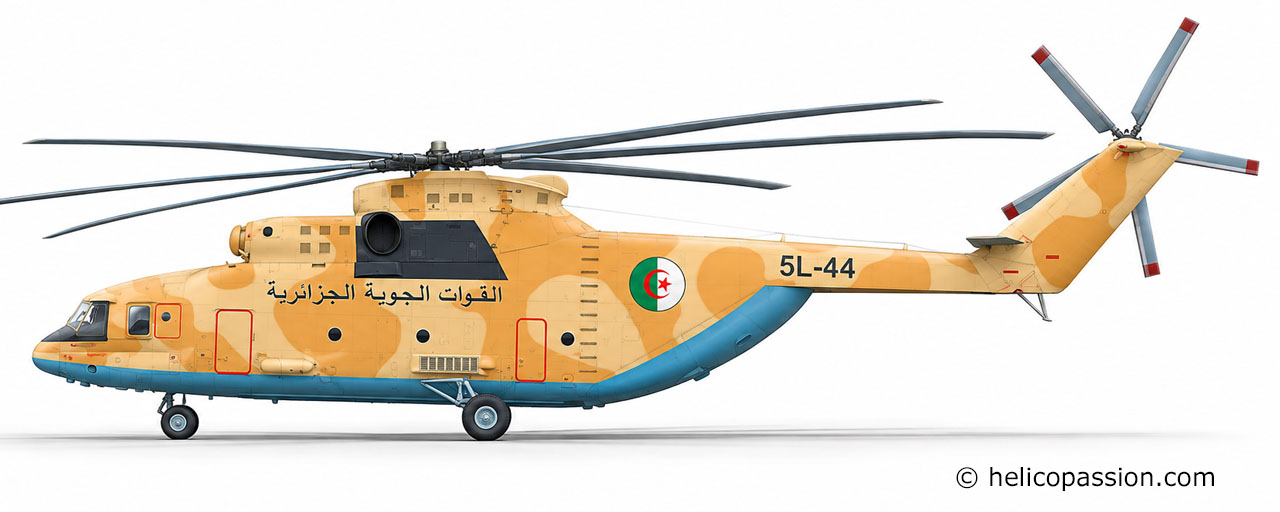 (Helicopassion illustration with AI)
Algeria — Air Force, Mi-26T2
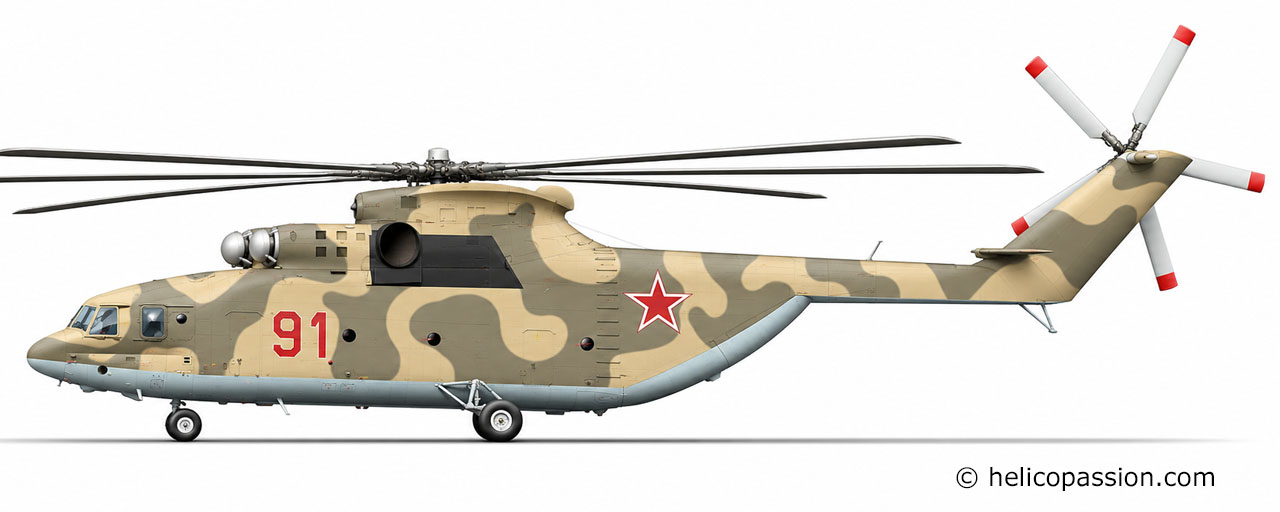 (Helicopassion illustration with AI)
Russia — Armed Forces, Mi-26, No. 91
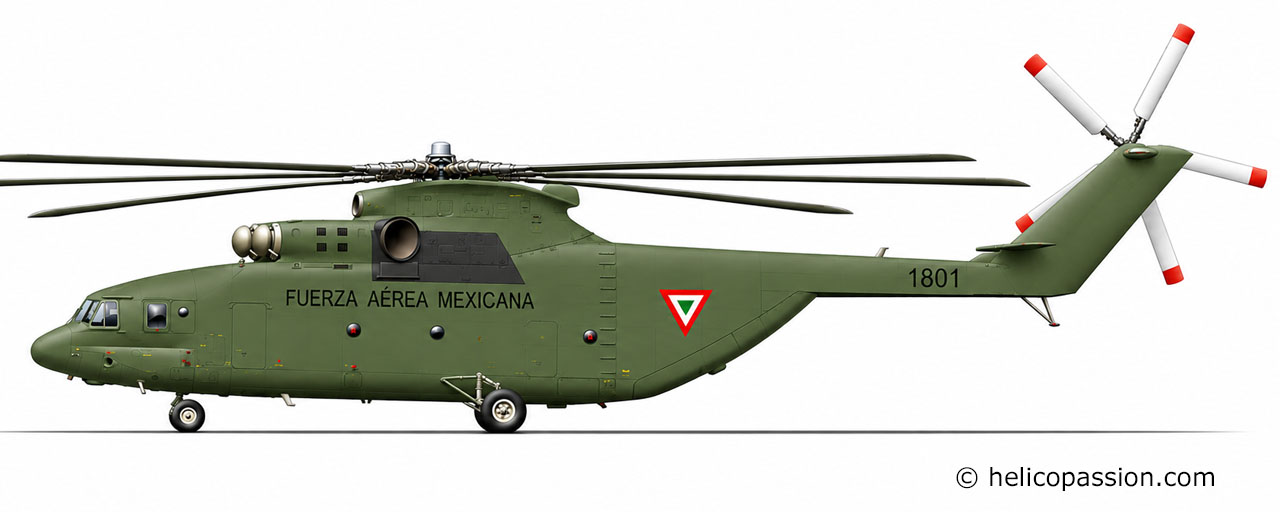 (Helicopassion illustration with AI)
Mexico — Air Force, Mi-26T
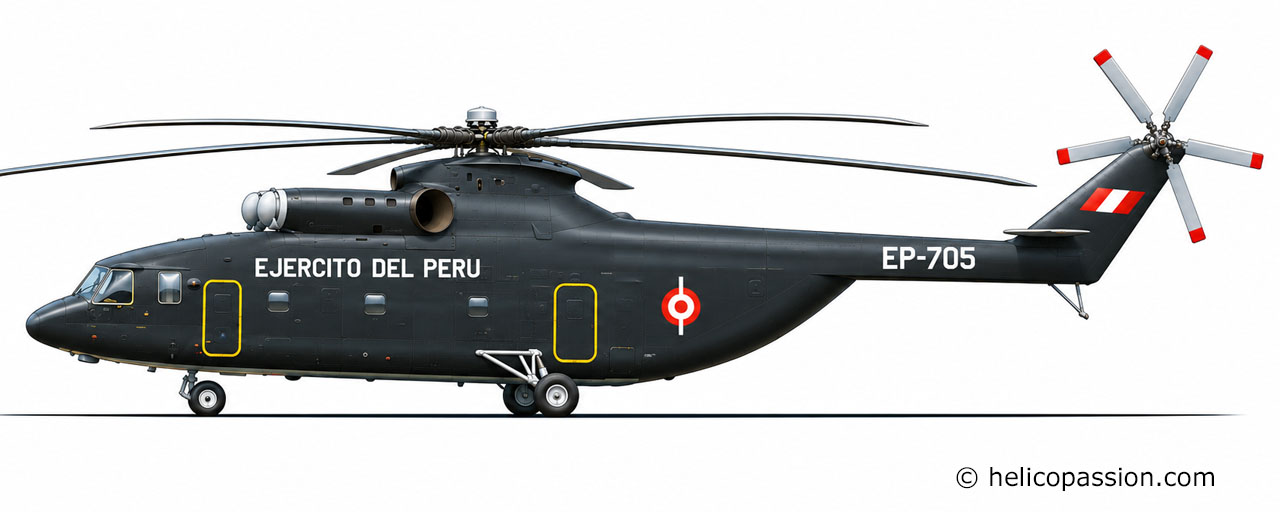 (Helicopassion illustration with AI)
Peru — Army Aviation, Mi-26T, EP-705
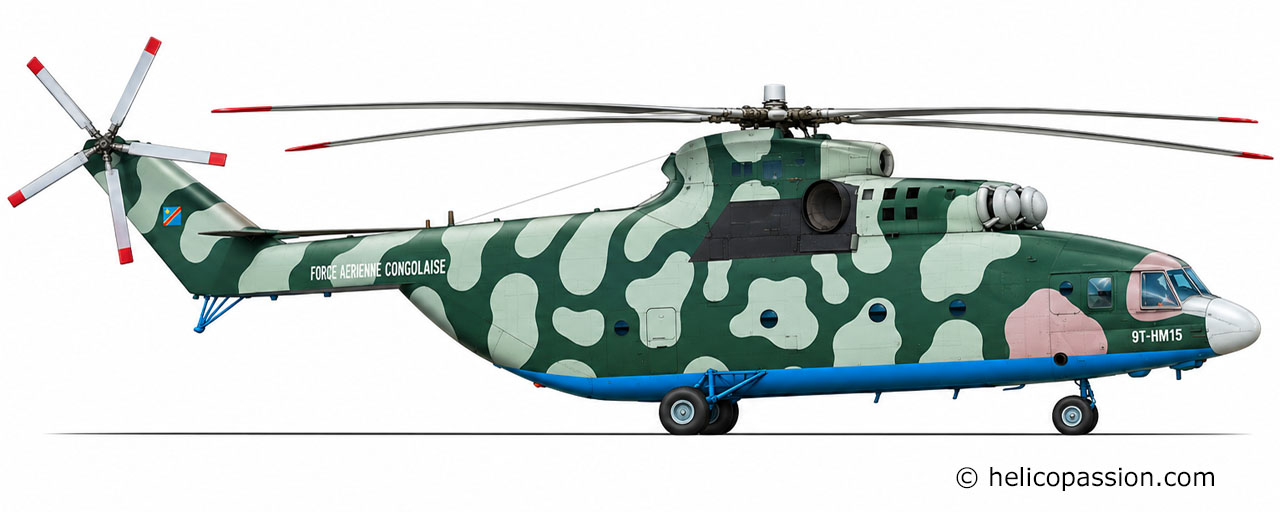 (Helicopassion illustration with AI)
Democratic Republic of the Congo — Air Force, Mi-26, 9T-HM15
Civilian operators
The Mi-26T became an important tool for Soviet industrial transport, particularly in Siberia, where oil, gas and construction projects often required equipment to be delivered far from established roads.
Following the dissolution of the Soviet Union, specialised companies continued these activities. UTair became a major operator, alongside companies such as Vertical-T, PANH and UralAviaTrans.
Civilian Mi-26 helicopters have also been used for firefighting, emergency response and logistical support to international operations.
Some have operated in support of United Nations missions, including deployments in Somalia, the former Yugoslavia, East Timor, Sierra Leone and Liberia.
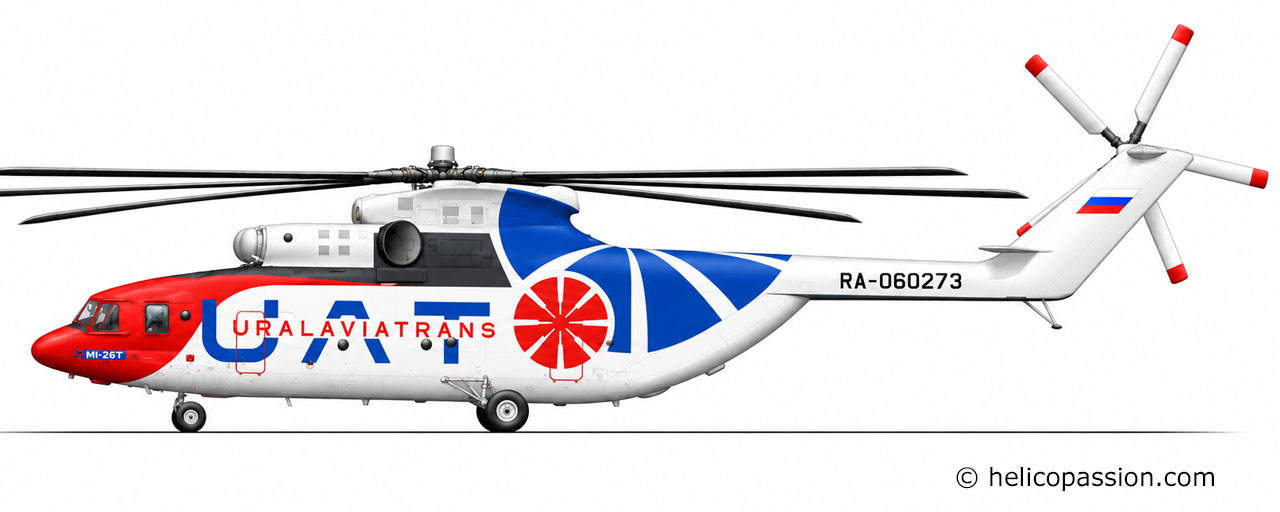 (Helicopassion illustration with AI)
Russia — UralAviaTrans, Mi-26T, RA-06273
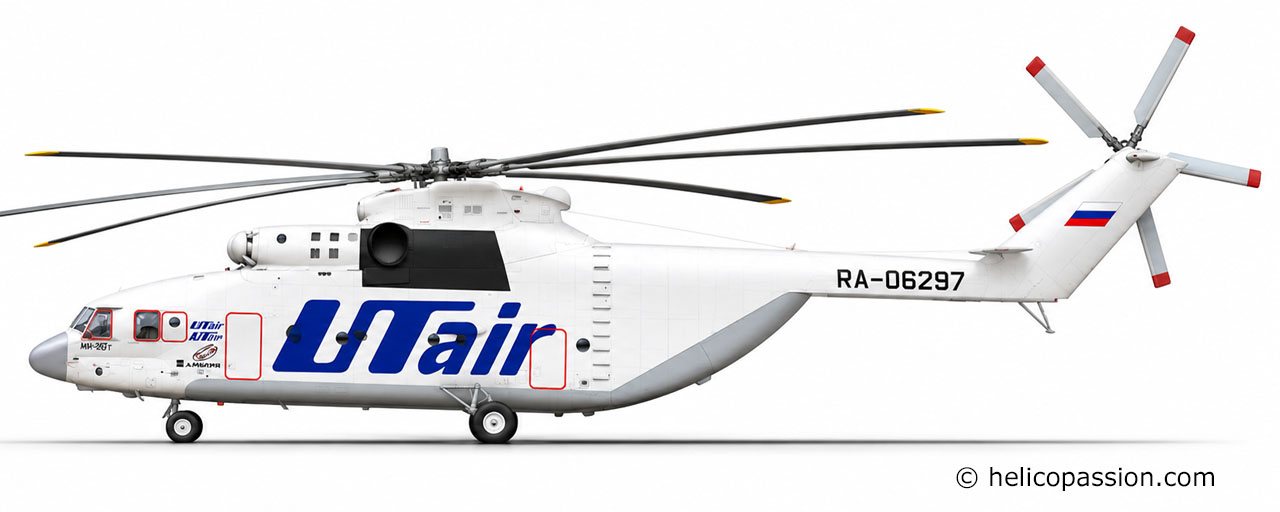 (Helicopassion illustration with AI)
Russia — UTair, Mi-26T, RA-06297
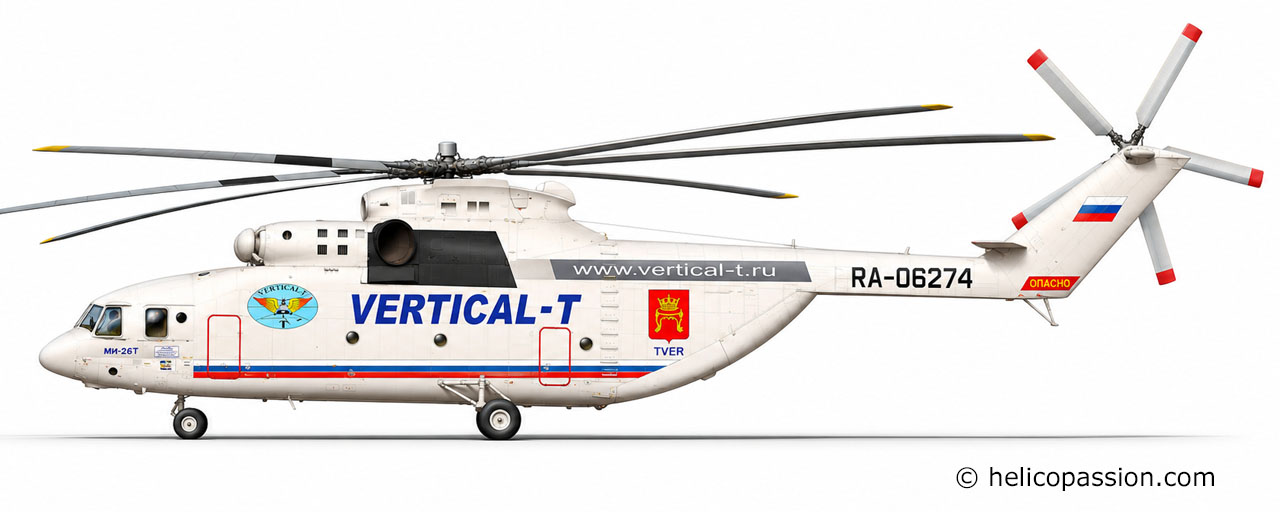 (Helicopassion illustration with AI)
Russia — Vertical-T, Mi-26T, RA-06274
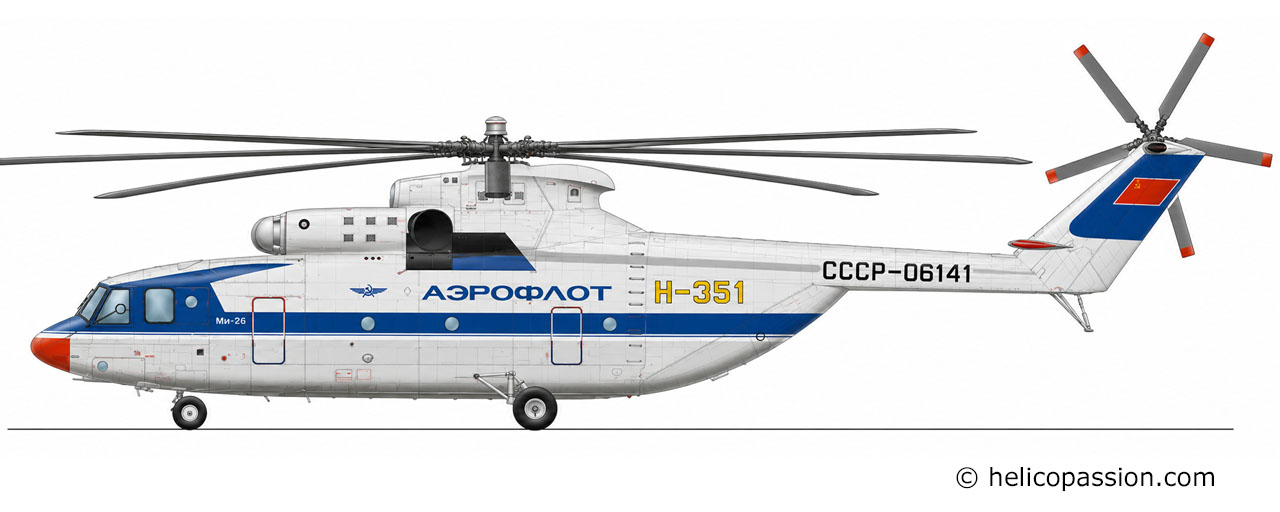 (Helicopassion illustration with AI)
Soviet Union — Aeroflot, Mi-26T
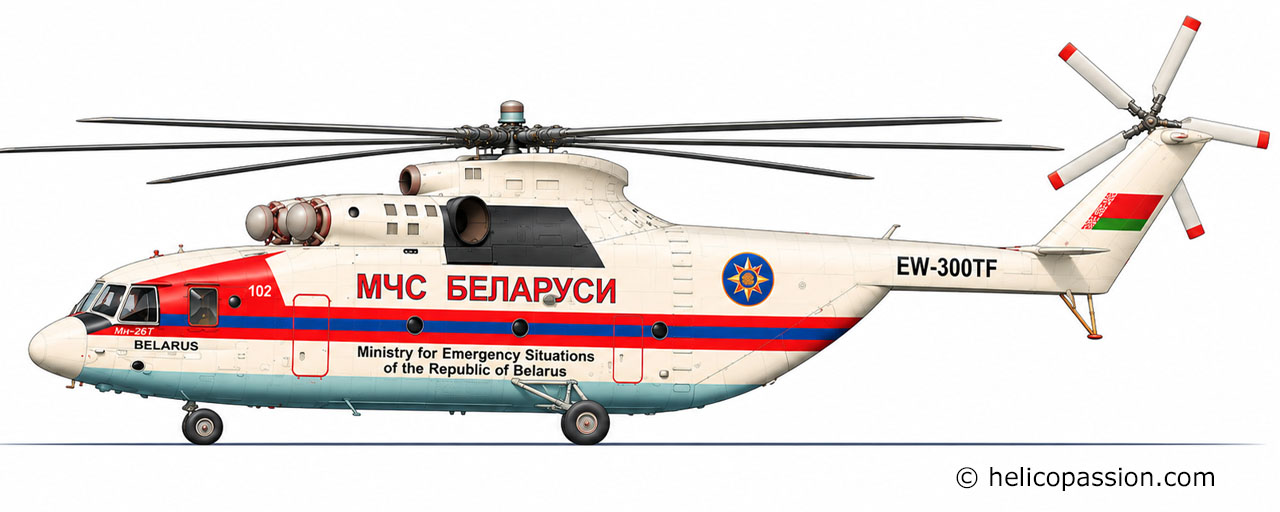 (Helicopassion profile with AI)
Belarus — Ministry of Emergency Situations, Mi-26T, EW-300TF
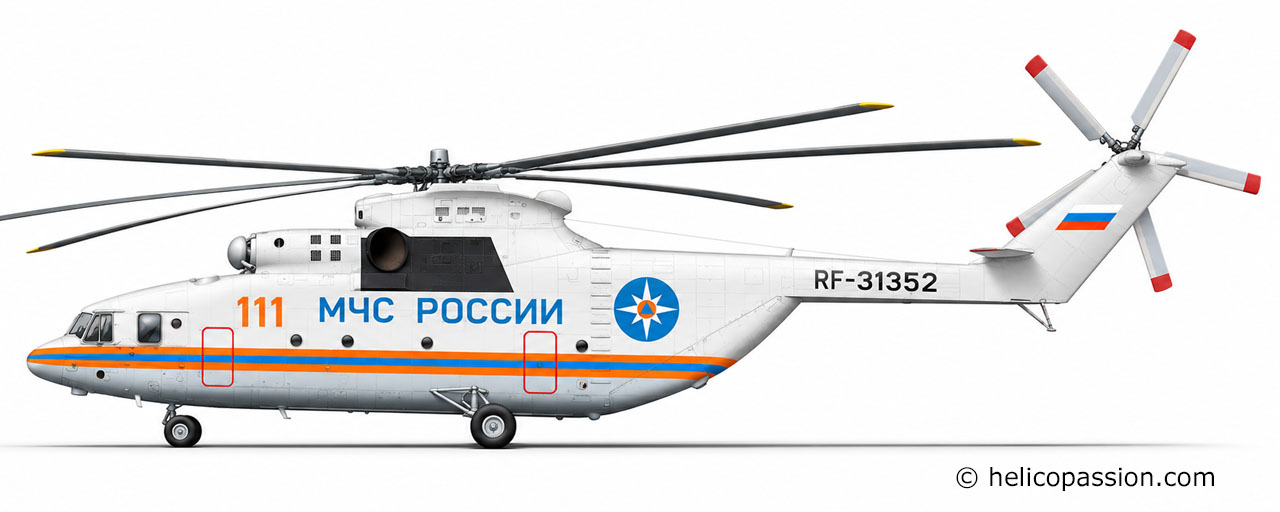 (Helicopassion illustration with AI)
Russia — EMERCOM, Mi-26T, RF-31352, No. 111
 (Helicopassion illustration with AI)
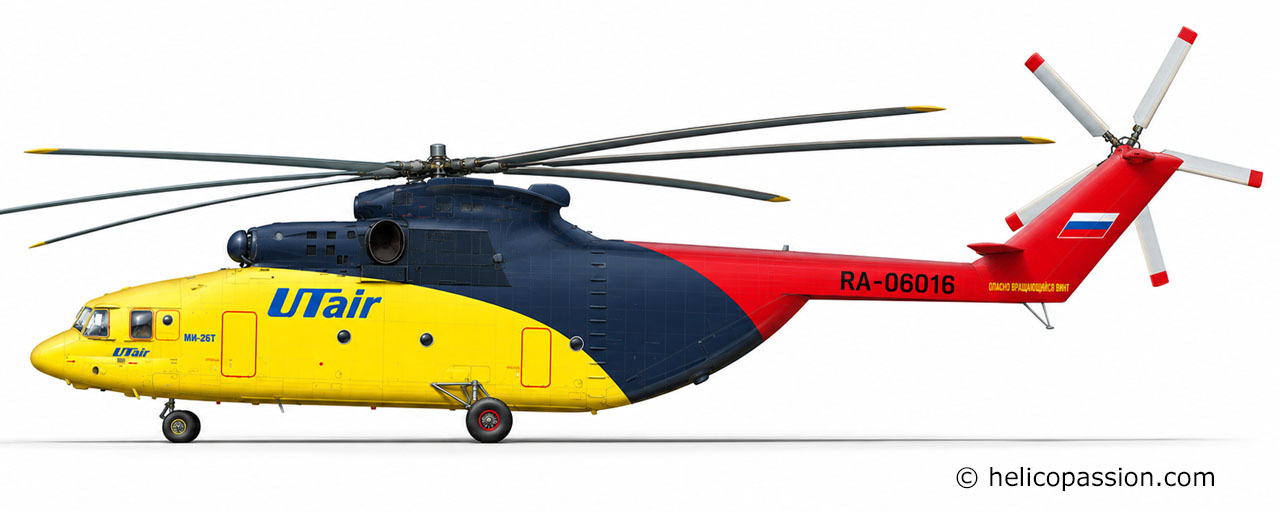
Russia — UTair, Mi-26T, RA-06016
 (Helicopassion illustration with AI)
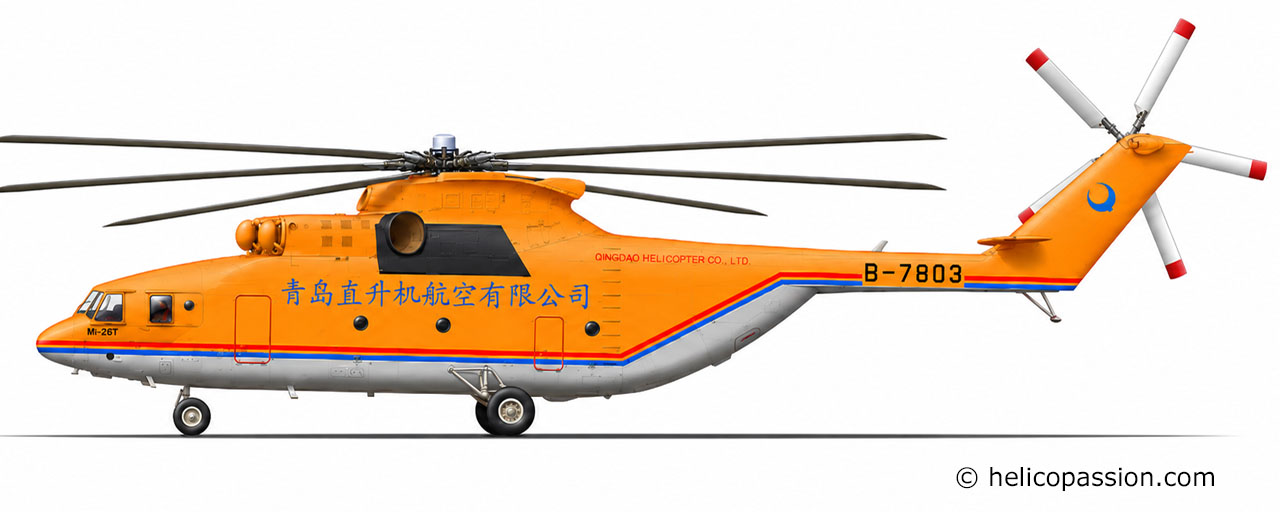
China — Qingdao Helicopter Aviation, Mi-26TS, B-7803
 (Helicopassion illustration with AI)
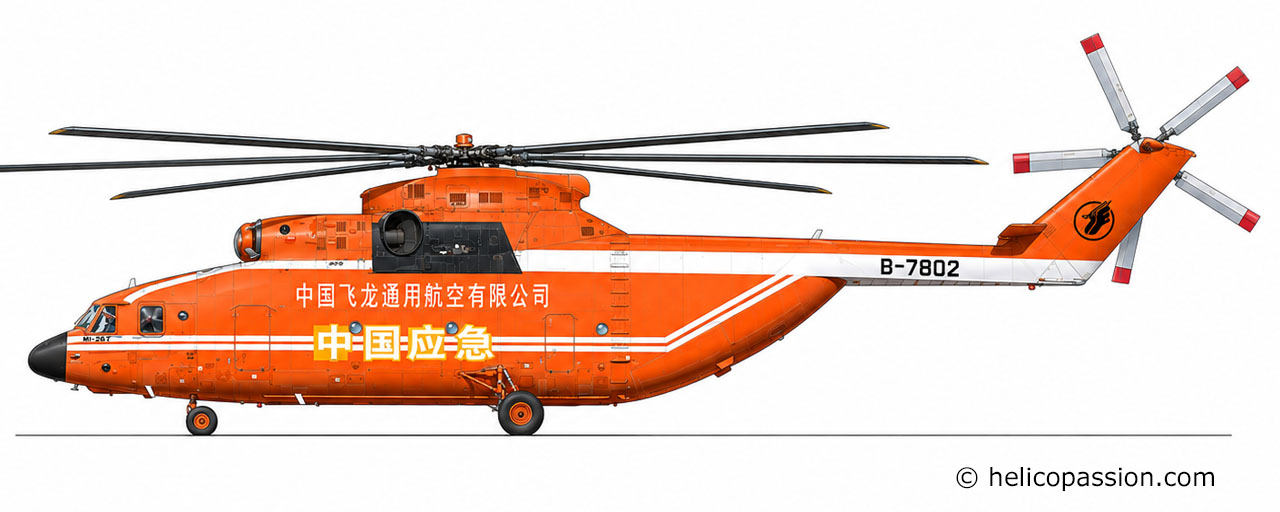
China — China Flying Dragon, Mi-26TS, B-7802
 (Helicopassion illustration with AI)
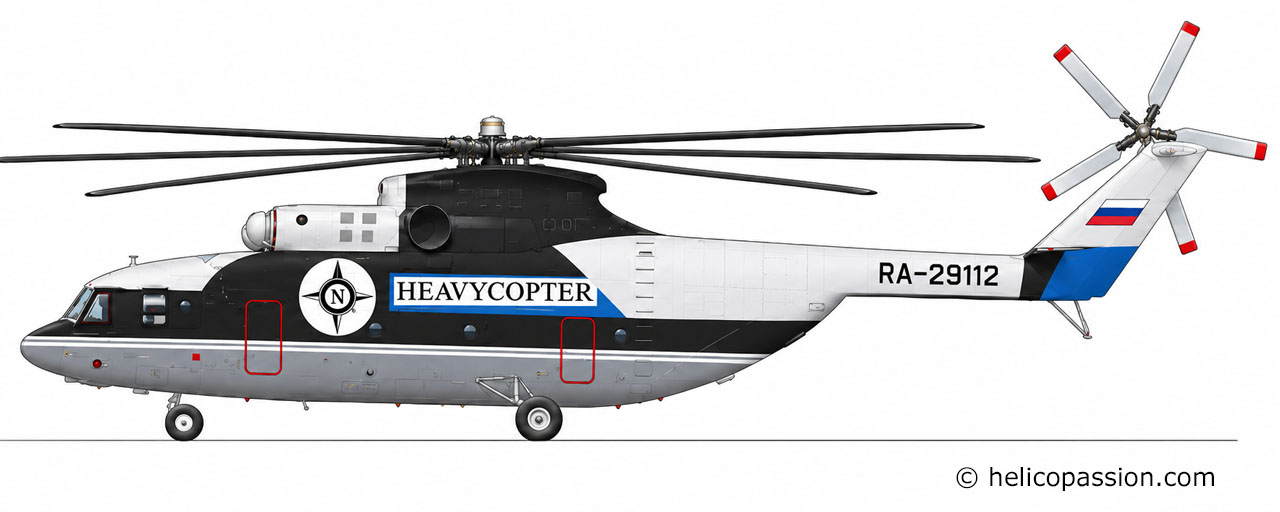
Russia — Heavycopter, Mi-26TS, RA-29112
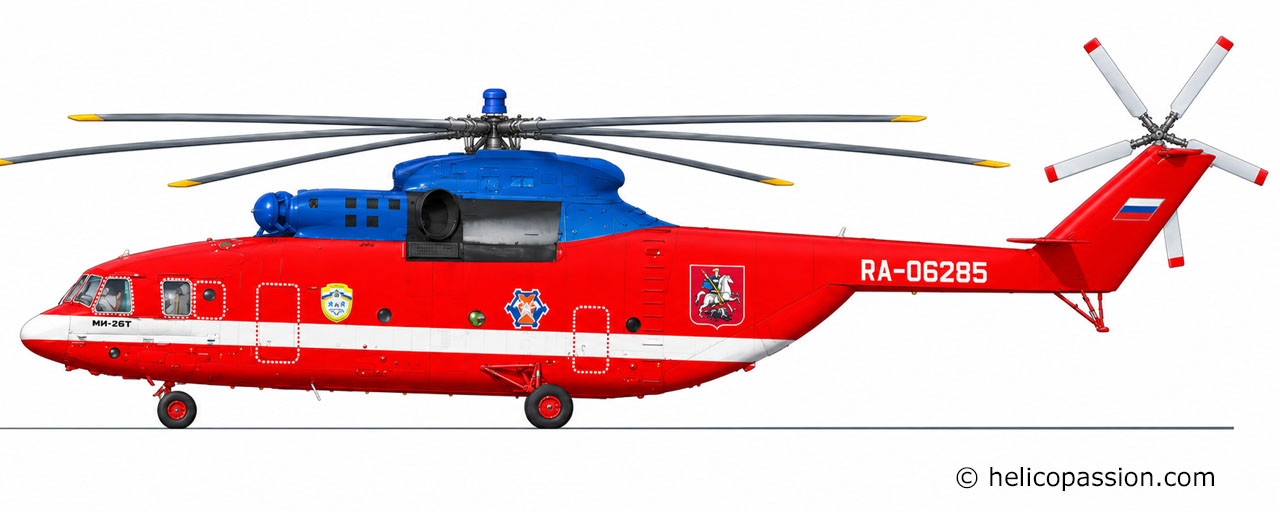 (Helicopassion illustration with AI)
Russia — Moscow Aviation Centre, Mi-26T, RA-06285
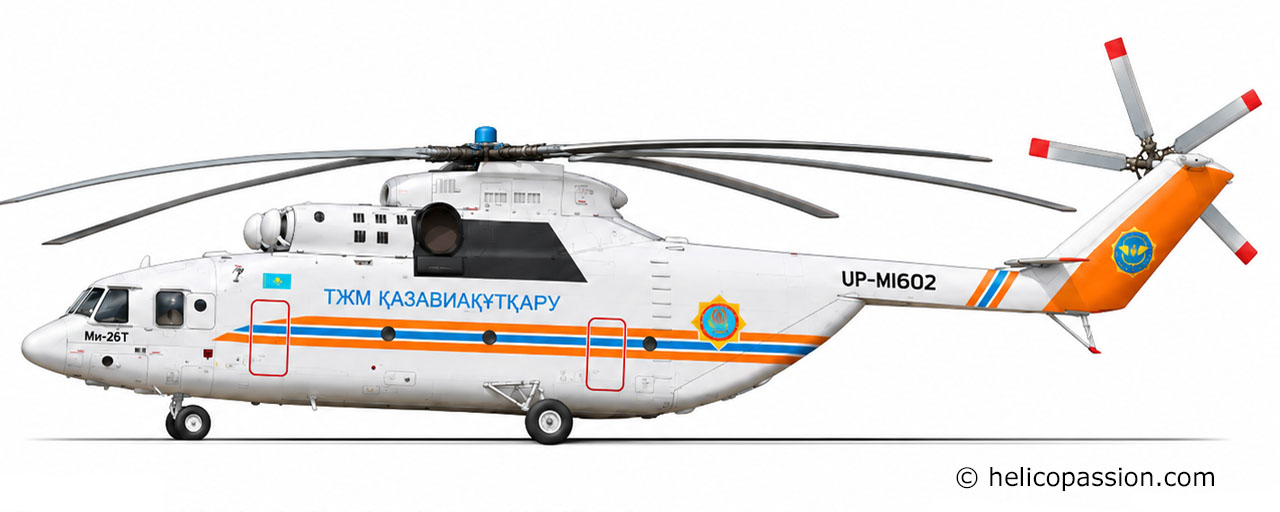 (Helicopassion illustration with AI)
Kazakhstan — Kazaviaspas, Mi-26T
Mi-26 historical reconstructions
Beyond its regular military and industrial work, the Mi-26 has taken part in extraordinary operations that demonstrate the versatility of its heavy-lift capabilities.
The following illustrations reconstruct three documented historical events. They are not original photographs, but visual interpretations based on historical and photographic references.
The Jarkov mammoth, Siberia, 1999
In 1997, mammoth remains were discovered on the Taymyr Peninsula in northern Siberia.
A scientific expedition led by French explorer Bernard Buigues subsequently prepared a large block of frozen ground containing the remains for transport.
On 17 October 1999, a Mi-26 lifted the approximately 23-tonne block and carried it some 230 kilometres to Khatanga.
The load exceeded the helicopter's nominal external lifting capacity of 20 tonnes, making this an exceptional operation.
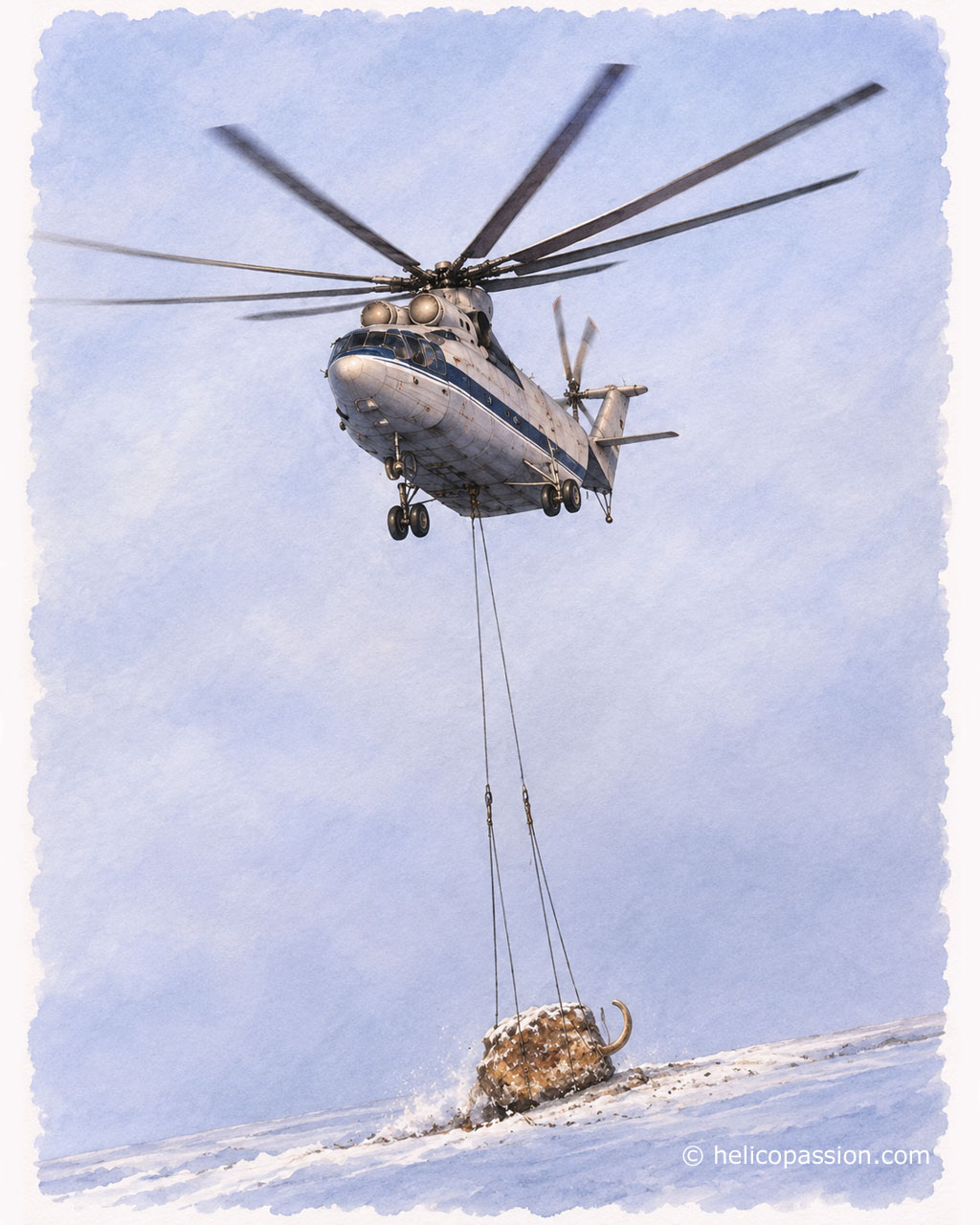 (Helicopassion illustration with AI, based on an archival photograph)
The Jarkov mammoth: a Mi-26 lifts a block of frozen ground in Siberia, 17 October 1999.
Alinghi 5 crosses the Alps, 2009
On 7 August 2009, a Mi-26T operated by the Russian Ministry of Emergency Situations (EMERCOM) and chartered by Heliswiss International transported the Alinghi 5 catamaran from Lake Geneva to Genoa.
The racing catamaran, weighing approximately 11–12 tonnes without its mast, was suspended beneath the helicopter.
The Mi-26 crossed the Alps near the Great St Bernard Pass at an altitude of around 3,000 metres, before making a refuelling stop at Biella in Italy.
The operation demonstrated the helicopter's ability to transport an unusually large and delicate load across mountainous terrain.
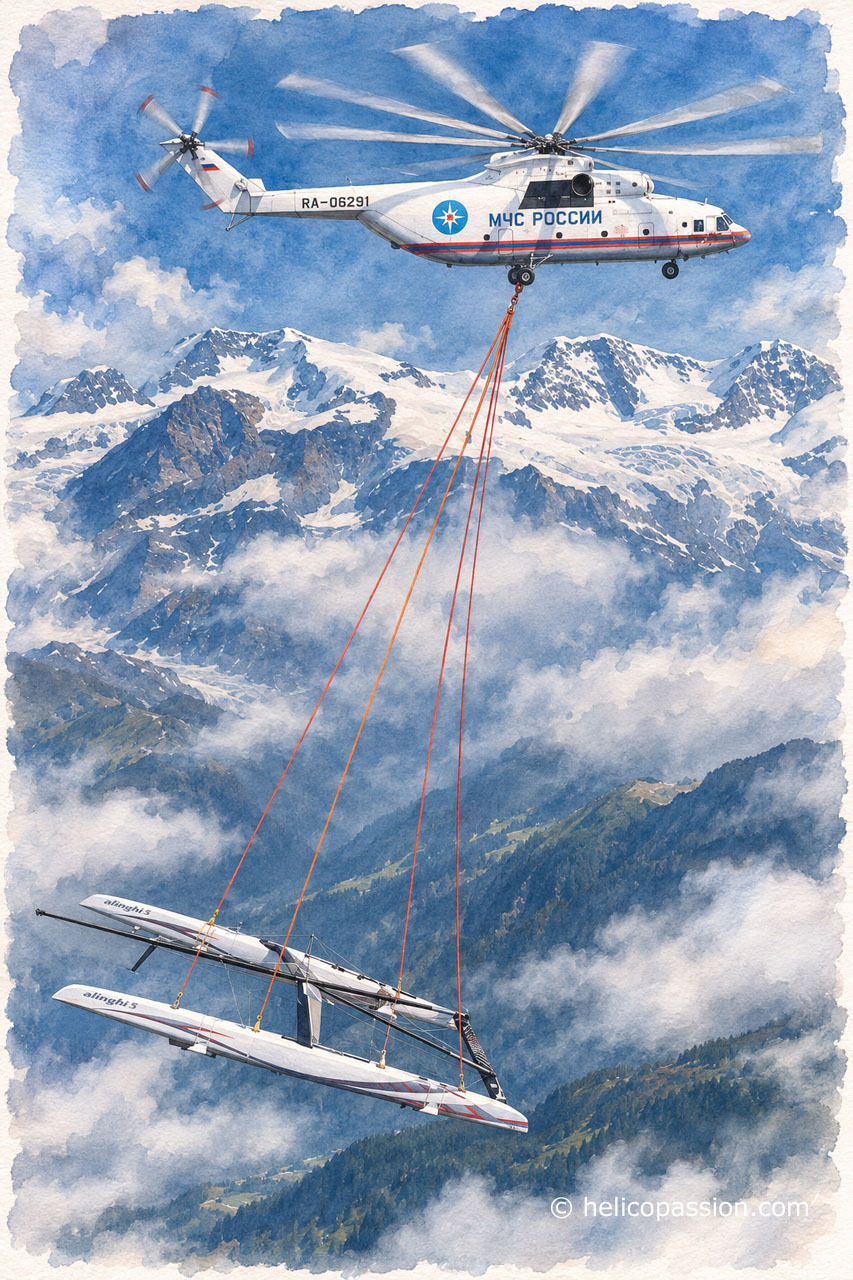 (Helicopassion illustration with AI, based on an archival photograph)
A Mi-26T carries Alinghi 5 across the Alps, 7 August 2009.
Chernobyl, Ukraine, 1986
Following the explosion of reactor No. 4 at the Chernobyl nuclear power plant on 26 April 1986, Soviet helicopters were mobilised for emergency operations.
Mi-26 helicopters participated in decontamination work and the transport of heavy equipment.
A specially adapted version, designated Mi-26S, was equipped with additional radiation protection and a spraying system used to apply a fixing liquid over contaminated ground, helping prevent radioactive dust from spreading.
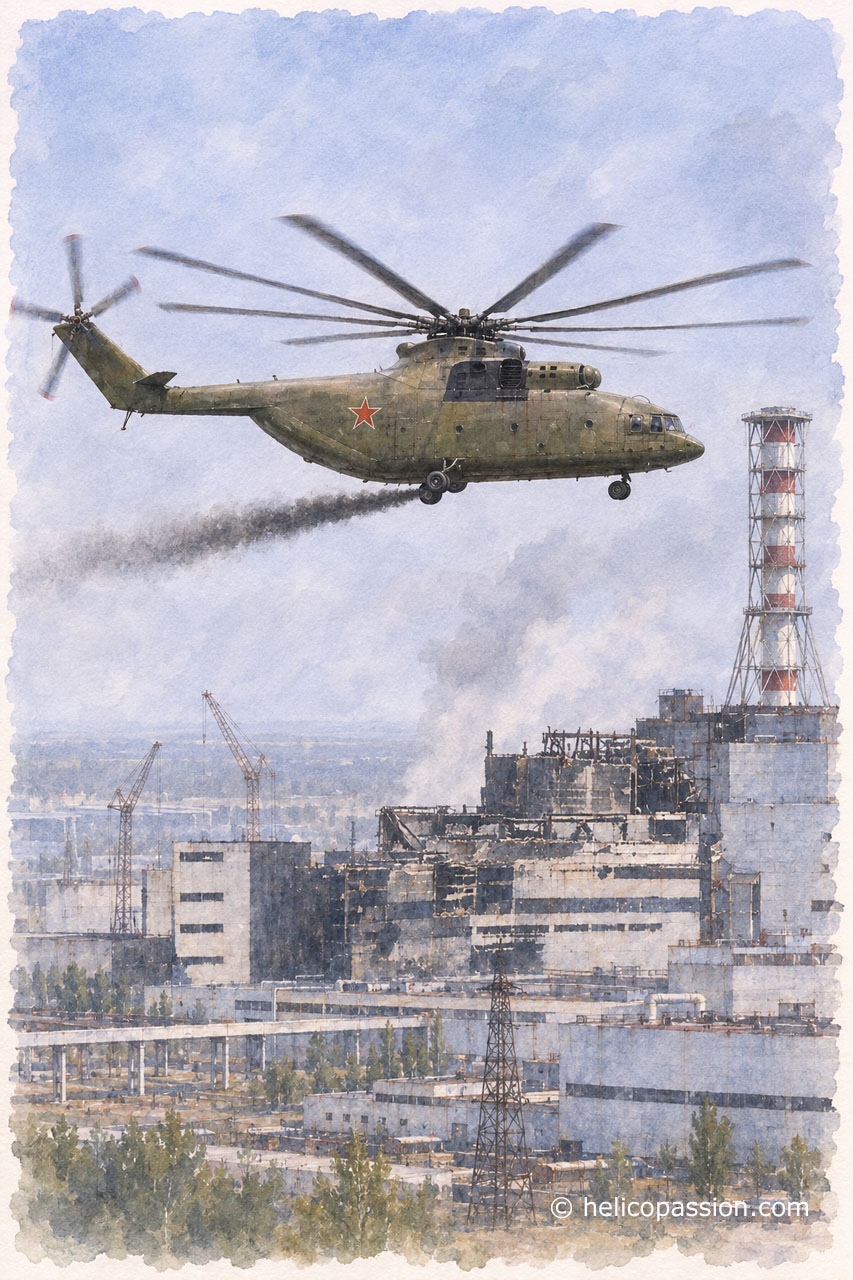 (Helicopassion illustration with AI, based on an archival photograph)
Mi-26 decontamination operations at Chernobyl, Ukraine, 1986.
Other remarkable Mi-26 missions
Recovering a Chinook, Afghanistan, 2002
During Operation Anaconda in March 2002, an American MH-47E Chinook was severely damaged in Afghanistan and could not be flown out of its mountainous landing site.
After the removal of major components to reduce its weight, the helicopter was recovered in April by a Russian Mi-26 operated by Heavycopter.
Carrying the dismantled Chinook beneath its fuselage, the Mi-26 transported it to Bagram Air Base.
The operation remains a striking example of the Mi-26's ability to recover another heavy transport helicopter.
Sichuan, China, 2008 and 2019
Following the devastating Sichuan earthquake in May 2008, landslides blocked rivers and created unstable lakes that threatened communities downstream.
Mi-26 helicopters transported heavy construction equipment to inaccessible locations, helping teams undertake emergency work to reduce the flood risk.
In 2019, a Mi-26 operated by China Flying Dragon was again employed in Sichuan, delivering construction machinery to the isolated mountain village of Abuluoha for the building of its first road connection.
These missions demonstrate how heavy-lift helicopters can support both emergency response and infrastructure projects in mountainous regions.
Mi-26 artistic illustrations
Photography is central to Helicopassion's approach to documenting helicopters and the people who operate them.
The following artistic illustrations reinterpret original photographs from two Helicopassion field reports. They are distinct from the historical reconstructions presented above.
MAKS 2013, Zhukovsky, Russia
During the MAKS 2013 aviation show near Moscow, Helicopassion photographed a Mi-26 during its flying demonstration, including a firefighting sequence.
One of André Bour's original photographs provides the basis for the artistic illustration featured on the cover of this Visual Collection.
Firefighting in the Var, France, 2003
During the summer of 2003, two Mi-26 helicopters from the Russian Ministry of Emergency Situations were deployed to help fight major forest fires in southern France.
The helicopters, numbered 005 and 020, were documented in a Helicopassion photographic report by Christian Vigne and Rodolphe Dehecq.
The illustration presented here reinterprets a photograph by Christian Vigne of Mi-26 No. 020 during its deployment in the Var region.
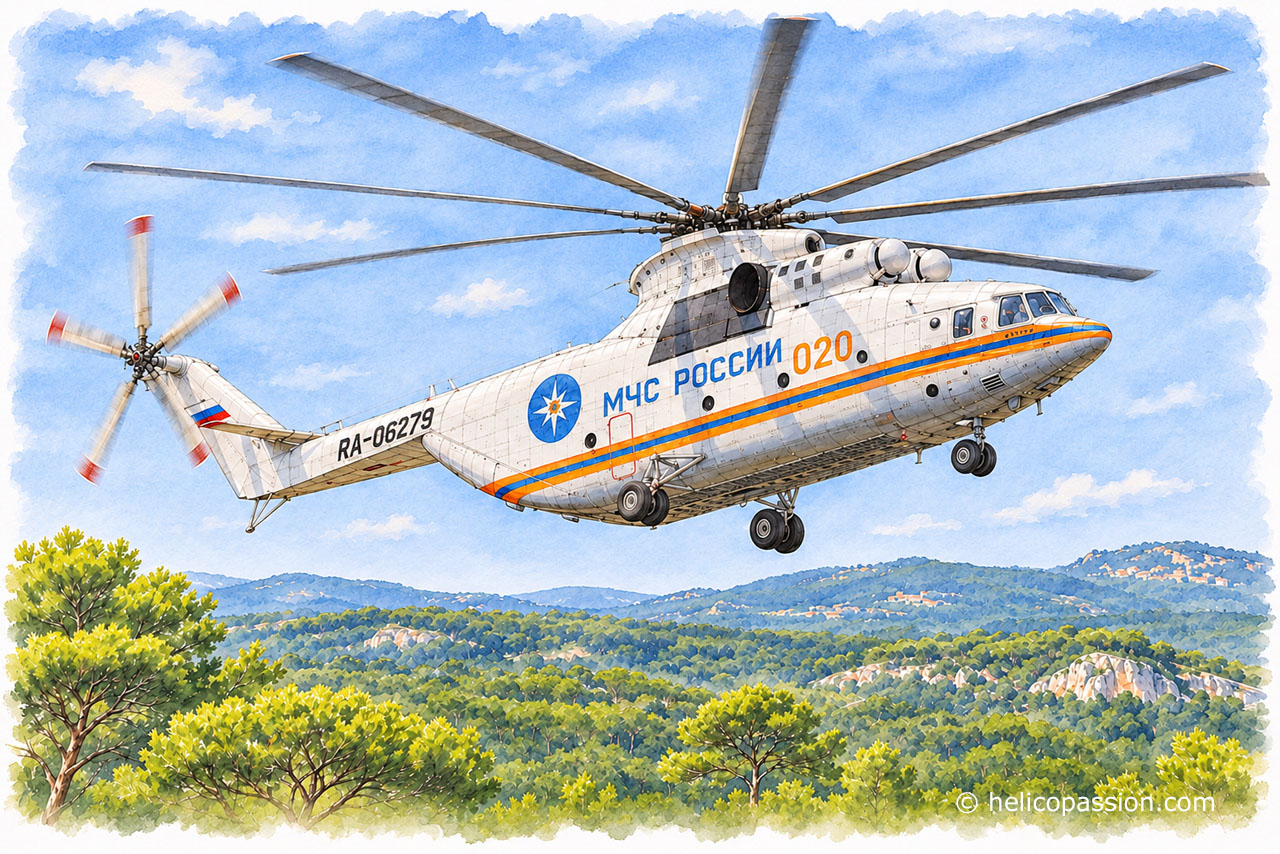 (Helicopassion illustration with AI, based on a photograph by Christian Vigne)
EMERCOM Mi-26 No. 020 fighting forest fires in the Var region, France, summer 2003.
Explore more
Helicopassion Visual Collection - Mi-26 Halo
Keep the images from this page in a visual booklet on your computer or smartphone.
Continue exploring Helicopassion
Complete Mi-26 dossier (in French)
Detailed information about the helicopter's development, technical characteristics, military and civilian operators, historical missions and photographic reports.
Military cargo helicopters (in English)
Discover the heavy-lift helicopters used by armed forces and compare their transport capabilities.
Helicopassion photographic reports:
MAKS 2013 - Mi-26
MAKS 2013 - Mi-26T firefighting demonstration
Var 2003 - firefighting